Rezoning 1030 and 1056 Burnaby Street
Motion 44 · Council Meeting, June 2, 2026
Summary
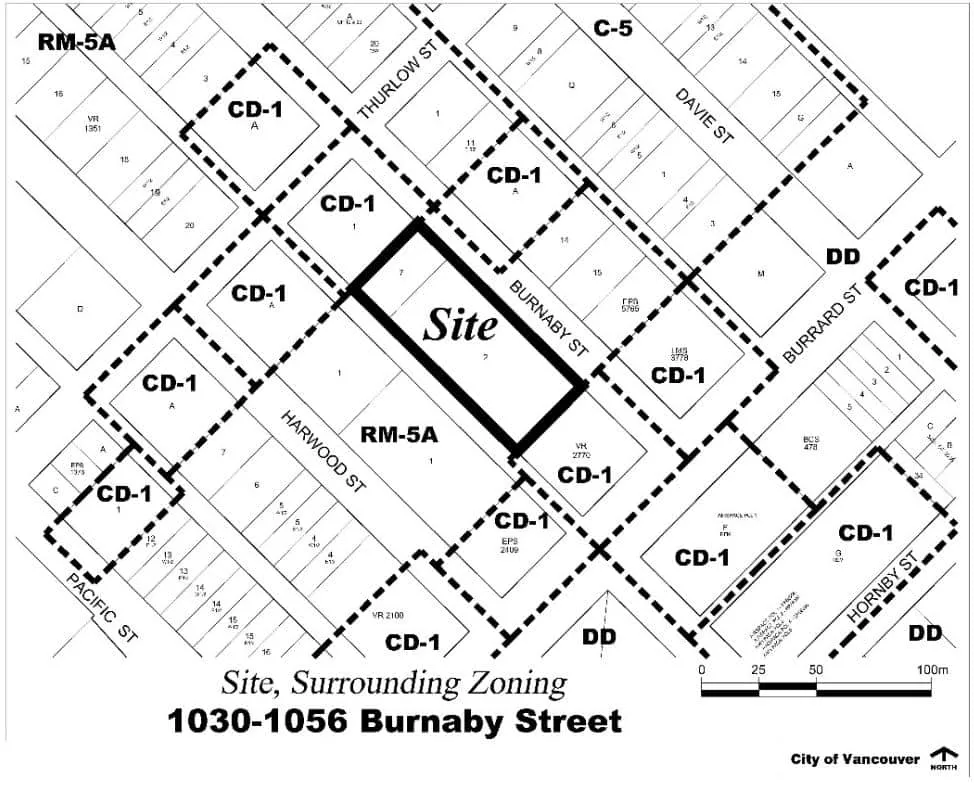
- The proposal involves rezoning two properties at 1030 and 1056 Burnaby Street in the West End from RM-5A (Residential) to CD-1 (Comprehensive Development) district.
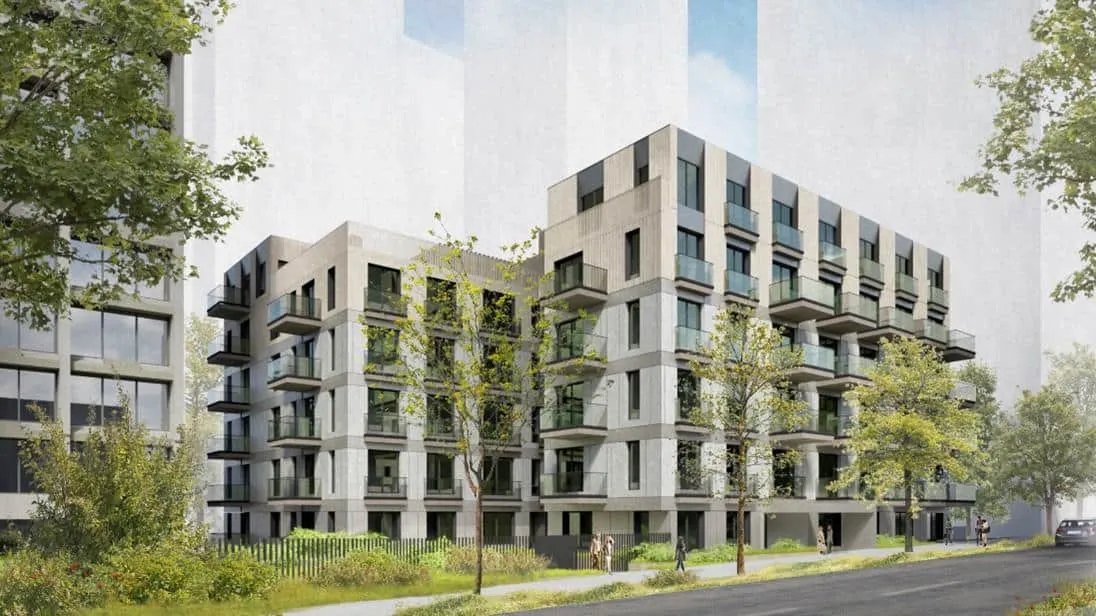
- The existing three-storey apartment building at 1056 Burnaby Street (built 1956) would be demolished and replaced with a new six-storey building containing 90 rental units, with a minimum of 20% of residential floor area secured as below-market rental housing.
- The existing 14-storey seniors' non-profit rental building at 1030 Burnaby Street (215 units, built 1972) would be retained and all its units secured as market rental housing going forward.
- Lot boundaries between the two parcels would be consolidated and subdivided to better accommodate the new development, with the 1056 Burnaby Street lot more than doubling in size.
- The application is consistent with the West End Community Plan's Burrard Corridor policies and the West End Rezoning Policy (Area E), which supports 100% secured-rental projects with 20% below-market units.
- The General Manager of Planning, Urban Design and Sustainability recommends approval in principle, subject to conditions including execution of a Housing Agreement By-law to secure the rental and below-market commitments.
Report Images
Vote
Public comments
💬 Neutral / information
Paolo Miralia Del Giudice Christian Di Sanzo Tracy Lawrenson Jamie Patel Micah Hilt Katya Tynan Paul Storer Winston Chao Lon LeClaire Saul Schwab
Statement Watch
The mayor can see him, a city Councillor, honorable Christian Dissans, a member of the Italian parliament who is attending for the first time this ceremony, community leaders, distinguished guests. On behalf of the Consulate General of Italy, I would like to express my most sincere gratitude to the city of Vancouver for once again proclaiming Italian Heritage Month this year. This recognition honors the generations of Italian Canadians whose hard work, talent, and civic commitment have contributed so much to the social, cultural, and economic development of this great and beautiful city. We are very proud of the strong ties between Italy and Vancouver and look forward to continuing to build bridges of friendship, cooperation, and mutual prosperity for many years I would also like to thank Mayor and all of you, City Council, for confirming your participation in this evening celebration of the Italian Republic Day, the 80th anniversary of the Italian Republic Day at the Italian Cultural Center. Your presence, we're very proud by your presence tonight. We look forward to welcoming you later today. at the Italian Cultural Center. And finally, I would like to take this opportunity to wish you every success in hosting the FIFA World Cup matches in the coming weeks here in Vancouver. Grazie mille and thank you very much again. Good morning, Mayor, Tim, Council, and distinguished guests. It's an honor to be here today to recognize Italian Heritage Month and celebrate the contributions of Italian Canadians. and what they've done for our city, our province, and our country. For generations, Italian Canadians have helped to build this city. Look around. Their contributions can be seen everywhere, from families and entrepreneurs who have helped to shape Commercial Drive in East Vancouver, as Mayor Simms said, to leaders in arts, culture, and construction, literally building our city, and Il Centro, who flies the flag all year long, along with the Consul. Italian Heritage Month is an opportunity to reflect on our legacy, but also to celebrate the vibrant Italian Canadian community that continues to enrich our city today. I would like to acknowledge Councillor Lisa Dominato for her leadership and Marin Council for their unanimous support of funding for Italian Day on the Drive. We've been breathing a little bit easier now that we know that we can make this all happen during FIFA. So thank you for your support. Italian Day is one of the largest events in the city of Vancouver. It's certainly the largest during Italian Heritage Month. And we look forward to welcoming hundreds of thousands of people and each and every one of you to the drive on June the 14th. Bringing together everyone to celebrate culture, community, food, music, and the enduring spirit. of Italian excellence. Don't forget, we have a past eating contest this year, so bring your stretchy pants. I would also like to thank the Commercial Drive Business Society, our largest sponsor, and a longstanding partner of Italian Day. Their support helps to make this celebration possible and contributes to the vibrancy and success of Commercial Drive and Little Italy throughout the year. On behalf of the Italian Day Festival Society, I invite everyone to join us on Commercial Drive on June 14th for Italian Day on the Drive, a free, family-friendly festival, thanks to all of you. where people of all backgrounds can come together, celebrate, and be Italian for the day. As we celebrate Italian Heritage Month, let us honor the generations who came before us, recognize those carrying the legacy forward, and continue building strong, welcoming communities for future generations. Thank you, and Viva Italia! All right. Buongiorno, Mayor Sim, councillors, and honoured guests. On behalf of Vilcentro, the Italian Cultural Centre of Vancouver, I would like to sincerely thank the City of Vancouver for once again proclaiming June as Italian Heritage Month. This proclamation is an important recognition of the generations of Italian Canadians who helped shape this city through hard work, sacrifice, entrepreneurship, and community building. From construction sites to family businesses, from restaurants and cafes to arts, music, and culture, Italians have profoundly, proudly contributed to the fabric of Vancouver for decades. The story of our community is deeply intertwined with the story of the city itself. I also want to acknowledge the efforts being made by Mayor Sim and Council to restore Vancouver to its former glory. We recognize that these are not easy challenges and we appreciate the work being done to improve public safety, cleanliness and the overall livability of our city. Strong communities and cultural vibrancy can only truly flourish in a city where people feel safe and proud of where they live. This year's Italian Day theme is Campione, champion. It is a theme that speaks not only to athletic achievement, but to the countless champions within our community and throughout Italy's history. There's a lot of them. Italy has long been a champion of exploration, invention, architecture, music, fashion, cuisine, design, and culture. Italians have consistently punched above their weight on the world stage, leaving an outsized impact on civilization and inspiring generations across the globe. And here in Vancouver, we are fortunate to have our own campioni, community builders, volunteers, business leaders, artists, tradespeople, and families who continue to strengthen and enrich the city every day. Grazie once again for this recognition, and on behalf of Il Centro, I wish everyone a meaningful, proud, and joyful Italian Heritage Month, and I hope to see you all tonight.
Statement Watch
Thank you so much. It's an honor for me to be here today. I'm a member of parliament in Italy representing an overseas constituency. I'm elected in North and Central America. I represent Italians that live in Canada and the United States. It's an honor for me to be here today in this recognition. I'm very grateful to the council to recognize this day as Italian Heritage Day. In Vancouver, today is the foundation of the Italian Republic. So it's a national holiday in Italy. It's a very important day. And it's important to celebrate the heritage of Italian-Canadian. I've been to celebration in Toronto and Montreal, and I travel all over Canada. And it's great to see the contribution that Italians and Italian-Canadian have given to Canadian society. The first Italians arrived in British Columbia in the late 1800s. They were owned by promise of the railroads, the mines, the fisheries on the Pacific coast. They were young men, mostly, and unfamiliar with English very often. and carry little more than their determination and the memory of everything they've left behind. And in the years, a small but vital Italian community had taken roots in Vancouver. They started opening grocery stores, cafes, and really helping lay the foundation of this city. We also have to remember that often Italians in Canada, as in the United States, they face hardship and discrimination. But through their resilience and their determination at the end, they were able to make extraordinary contribution to the Canadian society and the Italian-Canadian community has been giving extraordinary contribution to Canada. So I'd like really to thank you for recognizing that and recognizing the contribution of Italians in British Columbia. Thank you so much.
Statement Watch
Thank you. Tracy Lawrenson, Integrity Commissioner. The investigation that gave rise to this item was conducted by an external investigator appointed pursuant to the Code of Conduct. Their role was to review the evidence, make findings, and provide a report. You've received that report and have the separate question on sanctions, if any, whether they should be imposed. Ms. Patel is available to answer any questions about the report specifically. So I'll let her speak to any questions that arise from the report specifically. Thank you. Thank you.
Statement Watch
moment there we have a further presentation no okay no I was just being I'm just present to answer questions about the report which should be self-explanatory thanks thank you very much so council you have five minutes to ask questions please put yourselves on the queue councillor Montague I'll advance you go ahead
Yeah, thanks, Chair. I've got a number of questions, so I'd like to move for a second round.
That's moved, been seconded. All in favor? And that, I think that carried. Can I just get, Councillor, a show of hands again? One, two, three, four, five. Yes, that carries. Thank you. Okay, go ahead, Councillor Montague.
Thanks. I guess a question to Ms. Patel. First of all, do you have any experience or expertise in the recurring protests and rallies that occur
in Vancouver?
No. Are you familiar with specific people or groups who regularly attend or organize those rallies like the one on October 4th related to this complaint?
No. What was the occasion for the event held on October 4th at the Art Gallery? It's not within the scope of my retainer, Councillor. Okay. So the timing of the event was not relevant to the investigation? I'm not sure what you're asking around timing, but I mentioned in my report that it's not appropriate for me to be assessing the nature of that event, just the actions by your council members with respect to the Code of Conduct.
You've got a list of organizers of the October 4th rally in your report. I think it's on page 27.
Are you familiar with any of them? No.
So not being familiar with them, which organizations or groups did you research?
I did not research any of those organizations. That was not within the scope of my retainer.
Okay. So you didn't look into the past or present members of any of those groups, their board of directors, or the connections they have with other groups, either organizing groups with this specific protest or... or generally their affiliation with other groups related to similar protests in the city?
It's fair to say, Councillor Montague, and I mentioned this in my report, that I was not making findings as to the nature of that rally or who was in attendance.
Okay.
And that's not a finding that was made in the report. There's no findings made in terms of the nature of that rally, whether it was affiliated with terrorists or not.
Okay.
Who did you interview for your investigation? I interviewed Mayor Sim and I interviewed Counselor Orr. And did you have discussions with Counselor Orr's legal team or just Counselor Orr? Just Counselor Orr. Okay.
Did you speak with any witnesses?
No witnesses, but I obtained background information from administration, neutral information.
Okay, right. Because you actually state on, I think it's line 17, quite early on the report, you say, and I quote, it was unnecessary to interview witnesses. Is that correct?
That's correct.
Okay. So in my experience, if you don't interview witnesses, that can lead to potential investigative bias or what we used to call investigative tunnel vision. Would you have comments on that?
This is a fairly straightforward investigation because the actions were done in public. And my job is to assess those actions vis-a-vis the code of conduct and if there were relevant witnesses. that I determined as an investigator that need to be interviewed to have a fair and balanced and thorough investigation. I would have investigated or interviewed them, but I didn't determine there were any witnesses that needed to be interviewed. These are just findings around the code of conduct, not findings around other events that may have occurred in the City of Vancouver.
Okay, thanks. I see I'm coming close to my time, Chair. I'll come back on.
Thank you, Councillor Montague. Councillor Frye, go ahead. You have five minutes.
Yeah, thank you. And I just want to bring this back to the substance of this investigation because as I understand it, reading this report, the issue is not ascertaining who organized rallies or who didn't attend rallies, but really it's specifically the allegations contained herein relative to our code of conduct. Is that correct, basically?
Yes.
And so your findings substantiate that there was, and just for the record here, that Mayor Simm first and foremost violated Section 4.1A of the Code of Conduct when he held a press conference. Can you elaborate on why that was substantiated?
Yes, Councillor Fai, that section of the code requires the council members not to misuse the influence of their office. And regardless of intent, when it comes to reviewing the code of conduct, it's a pretty clinical analysis. And here, I didn't find that the press conference that was held on April 8th, 2025, was part and parcel of the exercise of the duties of office. And that section says that the council members must not misuse the influence of their office for events outside of their official duties. And on a balance of probabilities, I found that the press conference was not part of the mayor's official duties.
Okay, thank you for that. And then further into your investigation, you substantiate that there is sufficient information that Mayor Sim objectively harassed Councillor Orr, and contrary to Sections 2.A.E. and 3.4.C. of the Code. Can you elaborate on what those specifically referenced? And again, recognizing that your job here is to ascertain how this relates to the Code of Conduct.
It's an objective test. I don't have, as you know, I'm an impartial investigator. And I'm looking at whether the activities on the April 8th press conference amounted to harassment as defined in your report of conduct. And the concerns that I had here were that Councillor Orr was not given notice of the press conference. The context was social media posts that were made. several years before Councillor Orr was not given an opportunity to attend the press conference. He was a private citizen when those comments were made. There was concerns around acknowledging that these comments were taken out of context. And this is a newly elected Councillor whose values were being questioned. without any notice or without an opportunity to explain. And it also was outside Mayor Simms' obligation as mayor to be holding a councillor or to try to hold a councillor accountable in, quote, his official capacity as mayor when really it's for the electorate to do that. So on balance, when we put that together contextually in terms of the press conference and how it came about and what it was about, it's about a serious topic, but it's not the right place for time for Mayor Sim to be doing this. And it's a good learning opportunity in my opinion, but I have to, as an investigator, say whether I objectively think the code is... This was offside the code, and I objectively think this was offside the code.
I'm just going to interject. Councillor Frye, just for a moment, I'm going to stop your timer. Your timer wasn't put on when you started to speak. I'm going to consult with the clerks just to confirm. They were... I know we're pretty close to five minutes, but if they...
So we're just, clerks, can we just confirm how much time is left? So Councillor Fai has approximately 13 seconds on his clock. 15 seconds? 13 seconds.
I'll come back after.
Thank you. Thank you for that. Okay, go ahead, Councillor Montague.
Thanks, Chair. And I'm not sure I'll quite get through these, so if I may move for a third round.
Sorry, I couldn't hear that.
Third round, please.
I think we have to suspend the bylaws in order to do that, so we'll need a motion to do that first.
A motion to suspend the bylaws.
We need a seconder. Seconded by Councillor Zhou. All in favour of suspending the bylaws in order to do a third round? And that is carried. Now we'll need a motion.
Motion for a third round, please.
Okay, moved, a third round. Seconder, Councillor Meiszner. Can I again see hands up, just because it's really hard to count. Thank you, that carries. Go ahead, Councillor Montague.
Thank you, Chair. Ms. Patel, did you speak with EOPs at the Vancouver Police or anyone at the Vancouver Police in relation to the rally referred to in the Mayor's post on social media?
No.
Are you familiar with what EOPS is or what they do?
No.
So they're a section within the VPD. They have specialized officers who are involved in and responsible for the safety plans for events and protests in the city. They complete a thorough risk assessment, make determinations of policing needs based on that risk assessment and public safety. There are about 1,000 protests in the city of Vancouver every year. And they have experts who would be very familiar with the very groups and people who would have been directly and indirectly involved in that rally on October 4th. So my next question is, do you believe it's important to and appropriate to speak with subject matter experts?
When it's relevant to the findings I have to make, yes, but I didn't deem that as relevant. As I said previously, we're talking about a code of conduct investigation. This isn't, for instance, a defamation case. And I didn't make findings on defamation, Councillor. So, yeah, I think I'm saying this. But I guess that's not the scope of this investigation.
One of the aspects of the complaint was a social media post making a pretty substantial claim about the groups that are involved. And you decided that that was irrelevant to get subject matter expert opinions on the potential for those connections?
So this is not litigation, this is investigation. In this situation with respect to the rally, I did review Councillor Orr's comments made at the rally. And I looked at the video that was linked and determined that this was done in his private capacity. And that's where that stopped. It wasn't appropriate for me to be investigating and certainly not within the realm of a code of conduct. the administration of a code of conduct to be going into that level of depth. Because again, this is not litigation, it's investigation of behavior.
Okay. Other than counsel, or did you talk to any of the other scheduled speakers at the October 4th rally?
No.
Right. Because that was unnecessary to speak with witnesses. Correct. What local Jewish organizations related to either the press conference or the social media posts did you speak with?
Councillor, I spoke to Mayor Sim and Councillor Rohr and members of the administration to get background information, and that's it. No outside parties outside of the city of Vancouver.
Okay. Did you watch any video recordings of the rally on October 4th?
Just the statements made by Councillor. Okay. Did you attempt to track down? So the statements made by Councillor or you corroborated that through video? That's correct.
That's not mentioned in the report at all.
I disclosed that because there were concurrent other matters that were happening that were brought to our office. And so I need to say that I'm aware of that video, but there was nothing in there that would lead me to think. that there was anything more to be done. There is a paragraph in my report that talks about Councillor being entitled to attend these types of rallies. And my report speaks for itself on his attendance at that rally. And Mayor Simmel also links in his social media post a media article or media post or whatever. So it's important for me to look at what was the content of that post, which I did.
What video did you review? You said you reviewed video to verify Councillor Zara's comments. What video was that? Was that video that Councillor Orr provided?
No.
Where did that come from?
I think it was linked to what was sent in the complaint. I'm sorry. There's 18 complaints, right? So it's not, I think we're going off on a tangent here. It is... not part and parcel of my findings in this report. It's not how I arrived at my findings. The nature of my findings are squarely around what are contained in Mayor Simms' communications. We don't go off and do... extensive investigations on these types of rallies relevant to a harassment complaint under a report of conduct investigation. That would be outside of the scope. That is Councillor Montague's time. I'm going to advance. Councillor Maloney, you have five minutes. Thanks very much. This is your first round, just noting that.
Statement Watch
Hello, I'm Micah Hilt, the city's lead seismic policy planner, and I'm here today to walk you through a proposed seven-action, five-year plan that begins the critical work of reducing seismic risk in Vancouver's existing private buildings. Before I begin, I want to recognize that this work is taking place in the traditional unceded territories of the Musqueam, Squamish, and TTsleil-Waututh Nations. These nations have stewarded these lands since time immemorial. Their relations, title, and rights remain intact. I also want to note that these nations have oral and written traditions describing our region's seismic hazard dating back hundreds of years prior to the inclusion of seismic forces in our building codes and planning. I'll start out by reviewing Vancouver's seismic risk before I speak to the plan in front of you today. Vancouver is at daily risk of a damaging, life-threatening earthquake. While current models show a one in five chance of a very strong earthquake in the next 50 years, we could have an earthquake at any moment. Additionally, there is also much we do not know as the science continues to develop. For example, the 2010-2011 Canterbury earthquake sequence in Christchurch, New Zealand, occurred along a previously unknown or blind fault. Given the likelihood of a major earthquake in our region and this type of uncertainty, the city partnered with Natural Resources Canada and the University of British Columbia to develop earthquake planning scenarios and model the city's risk. These results that I'm about to review were presented to Council in late 2024. Modeling of a Georgia Strait magnitude 7.2 earthquake shows that the city can expect nearly 6,100 heavily damaged buildings. Many of these buildings will require demolition and replacement. Those that are repairable will require costly and lengthy repairs, displacing residents. In fact, this scenario is expected to disrupt and displace nearly one-third of residents for over three months. This number increases significantly when you consider workers and visitors and customers in the city during the day. This earthquake would lead to as many as 1,370 casualties and is expected to cause $17 billion in direct financial losses. That's replacement value. Recent research from the Insurance Bureau of Canada shows a similarly impactful earthquake could lead to over $130 billion in total economic losses. As you can see on the map, not all areas of the city are evenly impacted. Neighborhood risk is driven by concentrations of vulnerable, complex buildings. Also, not all buildings are equally vulnerable. Over half of Vancouver's buildings were built prior to 1973, when seismic forces were first introduced into the building code, and nearly three-quarters of buildings were built before 1990 or early modern seismic standards. Concentrations of older, seismically vulnerable buildings drive our risk. Modeling doesn't just show us the problem, though. It also helps us develop solutions. It shows us that 80% of risk is driven by 10% of buildings, less than 10,000 buildings. These types of buildings are older concrete residential and commercial towers containing 30% of our rental units and many of our region's largest employers. Unreinforced masonry residential buildings, or URMs, these are our heritage buildings and contain most SROs. Wood apartment buildings, like those in Mount Pleasant and the West End. Nearly 80% of these buildings were built prior to 1990. And smaller, older commercial buildings, like those along Granville and Kingsway. One in three of these buildings is modeled to be heavily damaged in an earthquake. Modeling also shows us that 65% of risk is concentrated in six neighborhoods, downtown, downtown Eastside, the West End, Kitts, Fairview, and Mount Pleasant. Areas of high concentrations of risk are on average comprised of nearly three quarters renters, of which 20% are low income. Taken together, this means that Vancouver's most vulnerable buildings and highest risk neighborhoods house the residents least able to recover from an earthquake. These same areas, particularly downtown, the downtown east side and the west end, could additionally face cordoning. Cordoning is where, because of concentrations of heavy damage, multiple blocks, even entire neighborhoods are closed to all access following an earthquake. In these areas, new and relatively undamaged buildings are inaccessible alongside heavily damaged buildings and collapsed buildings. The picture on the left here shows the cordoning that took place in Christchurch's Central Business District following the earthquake sequence I mentioned earlier. The cordon there stayed in place for over two years while over two-thirds of CBD buildings were demolished. In terms of building response, the image on the right shows the city's heavy urban search and rescue team exercising building collapse response in the 2019 Van Slam earthquake exercise. Collapsed and heavily damaged buildings will place overwhelming demand on FEMA, VPD, fire, hospitals, and shelters. Additionally, debris from heavily damaged buildings will block emergency service movements. All of this together, coordinating collapses, high level of risk that we've seen in the map before. Bottom line, a major earthquake will significantly impact Vancouver, and our current capacity to quickly respond and recover is quite low. Following a 2024 report on these findings, council directed staff to engage a broad cohort of interest holders and develop a strategy to reduce risk. Staff met with representatives from residential tenants and landlords, commercial building owners and operators, nonprofit housing operators, and international and local experts in seismic risk reduction. From that, we found that interest holders were highly concerned about seismic risk. We found broad support for this city taking action on risk reduction. We also heard that upgrade costs, especially amongst other expenses, as well as financing tenant displacement and protections, and the challenges faced by current VBBL-triggered upgrades were all concerns. Interest holders requested that the city continue to work directly with them when it comes to staff developing plan actions into policies and programs. Interest holders also requested a program that guides them on phased incremental improvements that allow for capital planning and financing upgrades better. Addressing these concerns is the focus of this plan. So where does this work fit into the city's overall effort to manage the impacts of an earthquake? There's infrastructure upgrades of bridges, like the Canby Bridge, and pipes and engineering. There's also managing the city's organizational risk, as well as planning for earthquake response and building community preparedness. This takes place in risk management in VEMA. And then there's buildings. New buildings are regulated through the BBBL. There's also the city's portfolio of around 700 buildings. These are managed by REFM's seismic program. And finally, existing private buildings. They are regulated by the VBBL primarily through Part 11 during times of significant renovations. Buildings, especially existing private buildings, are the focus of this proposed plan. The Building Seismic Risk Reduction Action Plan. I want to start off by explaining what this plan is not. It is not an open-ended, costly mandate to aggressively pursue seismic risk reduction in a vacuum. There are important constraints to consider. Limited city funds and resources, affordability, costs, potential displacement from upgrades and replacements. Also, many seismically at-risk buildings face additional challenges, such as overheating, maintenance issues, and others. Ultimately, our risk was built over generations, and reducing it will also be generational work. Pragmatic, careful risk reduction recognizes these constraints and balances risk reduction with those challenges. The plan also recognizes that progress is possible. Progress means increasing risk awareness and fostering partnership to create lasting solutions and focusing on existing city tools to accelerate action and approaches that reduce risk gradually and incrementally. This approach prioritizes creating opportunities and catalyzing progress, leading to even broader action. The approach acknowledges we cannot act alone, carving out a clear and manageable role for the city. Success generates senior government action. Planning was also guided by the experiences from other cities, from San Francisco, where a concrete safety program was adopted just last year. This program is voluntary. It builds on 25 years of community-city partnership and was driven by a public inventory of at-risk buildings. from Seattle, where their public inventory of high-risk URM buildings has galvanized the community. A community-led Fix the Bricks campaign, which you can see the poster for there, is underway, pushing all levels of government to protect beloved community heritage buildings. A quick overview of the plan before I move into detail on each action. Seven actions are taken over the first five years. The objective of the plan is to begin to jumpstart risk reduction. Each plan action is direction to explore or to develop various approaches or to support ongoing work. There are no regulatory policy or program changes today. First, establish a seismic risk reduction technical working group to guide the development of plan actions into recommended policies and programs. Then, develop an inventory of at-risk buildings. In parallel, develop a voluntary retrofit program helping owners upgrade inventory-identified high-risk buildings. These three initial actions together form the foundation of a plan. There are also actions that explore how redevelopment can increase risk reduction, how current regulation can be improved to more feasibly and effectively reduce risk, and how to support small businesses and vulnerable residents in high-risk buildings, and how to improve response and recovery planning. Action one, establish a seismic risk reduction technical working group. This group will be comprised of engineering experts, interest holder representatives, and community members, and will directly support staff in their work to develop plan actions into policies and programs. Similar groups in other cities were instrumental in developing durable, well-supported policies and plans. San Francisco, as you can see here in the photo, continues to use this approach today. This has led to lasting support for action, successful risk reduction in thousands of buildings, and attracted broader action, both regionally and at senior levels of government. Additionally, this approach builds trust between the community and government. It gives staff a direct link to the implementation of policies and programs, allowing for any changes needed along the way. Action two, develop an inventory of at-risk buildings. Seismic risk assessments, like the results we saw earlier, significantly increase risk awareness. But these assessments have important limitations. They are not based on inventory building assessments. Instead, they are based on high-level building type analysis. While this is helpful to broadly understand risk at the neighborhood, the city, and the building type scale, risk awareness that drives risk reduction requires individual building scale findings. To understand individual building risk, seismic screening is often used. This is where a building is observed on site from the exterior by a design professional. A risk rating is then determined using those observations. Government building records and findings from technical studies, like the study that's appended to this report, are used to improve observations and ratings. The inventory, then, is a listing of all buildings with a seismic risk rating next to it. Inventories in many cities have significantly advanced risk awareness and led to action. You can see in the photo on screen here community members supporting Everett's efforts to develop their inventory of unreinforced masonry buildings. Inventories make the problem individual, tangible, and clear. This motivates upgrades and sustains support for action. It allows us to prioritize limited resources. It also significantly enhances senior government funding asks. Finally, inventories provide information that increase our ability to respond after an earthquake. Collection methods, timeline, and the release approach will be developed with the working group. Action three, develop a voluntary seismic retrofit program that supports incremental upgrades. This program complements inventory followings, offering clear, costed, stepwise paths to improving building safety. Specifically, the program will consist of a set of standards that pair seismic upgrades with common building improvements. This allows building owners to identify opportunities to add on seismic upgrades to existing, often capital-planned work. Similarly, it shows the potential for building improvements that could be undertaken alongside seismic upgrades, improving the financing potential for those upgrades. Overall, this program moves us beyond our current all-or-nothing thinking about retrofits and focuses on advancing safety gradually and in a way that better protects tenants. But this program won't deliver retrofits overnight. It will, however, lower barriers by breaking retrofits down into smaller, more achievable pieces, making upgrading more likely. Alongside risk communication, upgrade incentives, and city-building pilot projects that demonstrate the potential of upgrades, upgrading becomes even more likely. When we consider advocacy to senior government for funding streams, financing tools, and other action, a voluntary program that delivers, upgrades, positions the city well to advocate to senior government. Action four, explore redevelopment and how it can be an effective approach to risk reduction. Each building that is replaced with a new building through redevelopment reduces risk. At the same time, redeveloping buildings often leads to renter and small business displacement. We also know that there are limits on what redevelopment can achieve. Because of existing site height and density and considerations like neighborhood character and infrastructure, some sites are far less likely to redevelop than others. Work within the Official Development Plan offers opportunities to explore how current plans can reduce risk and to identify new opportunities to reduce risk while protecting tenants and small businesses. Action 5. Identify improvements to our current building regulation and processes to advance risk reduction. This action looks at the VBBL Part 11, or renovation-triggered building upgrades, as well as our building record-keeping systems. We heard during engagement that some renovation-triggered upgrades were challenging for some building owners. Staff will work with the technical working group to identify specific opportunities to streamline and improve these regulations. to more achievably and consistently deliver risk reduction. Staff will also review how we track seismic hazard areas, building scale seismic risk data, and building upgrade records to make that information more readily and easily available as we work with owners to improve their buildings and projects. We also know from seismic engineering experts that new buildings are designed for life safety, not repair and not recovery. This means many new buildings will require extensive, costly, and lengthy repairs after even a moderate earthquake. In a large earthquake, many will require demolition and replacement. Staff will work directly with industry to identify opportunities where repairability and recovery can be achieved cost-effectively and reasonably through new building design. Action six, identify and replace, sorry, identify and reduce the impacts of seismic risk and building upgrades on disproportionately impacted populations. Renters cannot improve their buildings, and in many cases, both renters and small businesses alike are unable to move to safer buildings should they choose. Additionally, seismic upgrades can lead to tenant displacement and small business displacement. During an earthquake, these same renters and small businesses will face additional burdens to recovery. Staff will assess these challenges to risk reduction and report back with recommendations to reduce these impacts. This also includes SRO residents, almost all of which live in the city's oldest and highest risk URM buildings. Staff will use findings from the at-risk building inventory and voluntary retrofit program to support ongoing efforts to upgrade and replace SRO buildings. Action 7. Develop approaches that accelerate post-earthquake building reoccupancy and citywide recovery. Reducing risk is essential, but it takes time. A comprehensive approach to managing risk, considering risk, it means, we'll start that one again. A comprehensive approach to managing risk, consider, it means requiring, I'll get there. A comprehensive approach to managing risk, considers risk that has not yet or cannot be eliminated. This includes supporting response and recovery planning. Staff will support ongoing city efforts with inventory and risk assessment data. Staff will also work to develop post-earthquake reoccupancy and repair standards to support a quick recovery of buildings after an earthquake. Additionally, as staff responds to an earthquake, city buildings become essential to response and lifelines for the community. Staff will support ongoing REFM work with a focus on increasing capital upgrades and replacements of at-risk city buildings, especially those in the city's highest risk areas. In conclusion, reducing risk is complex, generational, and costly work, but significant progress can be achieved. This plan will not earthquake-proof Vancouver. No plan ever can. and achieving broad seismic resilience requires partnership across all sectors and all levels of government. This plan makes progress by carefully folding seismic risk reduction into our current plans and policies. It recognizes today's challenges and constraints. It does this by prioritizing partnership, increasing risk awareness, and finding practical solutions. This plan jumpstarts the work and sets a strong foundation for lasting risk reduction in Vancouver. Thank you so much for your time and consideration. I'll take any questions you might have.
Statement Watch
Katya Tynan, Manager of Resilience and Disaster Risk Reduction with the Emergency Management Group. So yes, we do work closely with Vancouver School Board and all kinds of other provincial partners around our response planning for earthquakes and seismic risk. We also do have distinct programs from schools. So we have our own containers of supplies. our own plans and our own procedures to leverage civic facilities like community centers and libraries, as well as work with our partners in engineering on works yards and all kinds of other things that are, again, distinct from the Vancouver School Board ones, which are meant to be for students and the school itself. So there is kind of a networked approach that we take of looking at the sort of overall response plans that we have around the place.
Statement Watch
I'll wait for the presentation to come up. Okay, perfect. So good afternoon. I'm Paul Storer, Director of Transportation, and I'm here today to present the Vision Zero Safe Mobility Plan. First, I'm going to spend a couple minutes at the beginning updating Council on some of the trends and ongoing work in transportation. So all of our mobility work is guided by a number of policies, including Transportation 2040, Vancouver Plan, Transport 2050 from TransLink, and many other plans. Transportation 2040 is our overall guiding policy, which lays out how we need to adapt the transportation network to meet the demands of a growing city with limited road space and to keep people and the economy moving and to improve the health and safety of Vancouver residents. The plan, which was passed in 2012, was also the first time that the city set a goal to eliminate serious injuries and fatalities on the transportation network. So it recognizes that to keep the city moving, we can't add more cars to the network. Instead, we need to provide good ways for people to get around without driving. The set a target of two-thirds of all trips be by walk, bike, and transit by 2040 as a way to achieve that goal. The Climate Emergency Action Plan accelerated that goal by 10 years, and this was about reducing the number of cars on the street to reduce emissions in Vancouver. So every year we do a travel survey of Vancouver residents. So the yellow bars are driving, blue is transit, and dark and light green are walking and cycling, respectively. 2025 saw a slight drop in the number of trips overall, with a slight increase in sustainable mode share, about 1%, although it's all kind of within the margin of error for the study. It's a positive result overall, but not a big year-over-year shift.
So I'm going to talk a little, sorry, on the wrong thing.
So I'm going to move on and talk a bit about the work we've been doing to speed up buses around the city. So this has really been one of our focus areas coming from this council. Council directed staff to advance nine priority corridors to achieve a 10% travel time savings on each corridor. So two-thirds of all transit trips in Vancouver are by bus, and speeding them up is very important to make them work better for Vancouver residents, as well as reducing costs for TransLink to operate them. This year, working with TransLink, we finished the planning and design on several corridors and have begun to implement the changes. Granville Street was the first of them with new bus bulbs in South Granville and extended bus lanes on the rest of the corridor. So this work is essentially complete now with just a few more touches left on the bus bulbs. The next projects are Kingsway and Main, which includes bus lanes, longer bus lanes, improved stop spacing and intersection improvements. And it's currently in the process of being installed, with that happening over the next several months. Bus lanes along 49th, east of Canby, are also going to be installed later this year. A number of the corridors have also had bus stop adjustments in advance of other bus priority work, working with TransLink. So overall, we're on track to double our bus lane hours by 2027, and this is going to have a huge benefit for people getting around by transit in Vancouver. So subject to funding, a lot of which we hope comes from TransLink, we're going to continue with the rest of the corridors that were directed by Council over the next few years. Obviously, one of the big moves for people getting around Vancouver and the entire region is the opening of the Broadway subway. It's scheduled to open a little over a year from now. And it's making good progress, and they're starting to test trains on sections, as well as rebuilding the street at safe station sites, starting with Main Street. So now I'm going to move on to the Vision Zero Safe Mobility Plan, the focus of the presentation and the council report before you. About 11 months ago, Council directed staff to develop a Vision Zero plan. The direction from Council included reviewing other municipalities worldwide, prioritizing measures shown to reduce serious injuries and deaths, and engaging with stakeholders on the plan. The plan in front of you provides a clear roadmap for improving safety in Vancouver. It builds off of other policies and learnings from both Vancouver and from other cities across the world. It includes a new time-bound safety target for us to work towards, a framework to guide our work over the longer term, and actions for meaningful near-term progress. To develop the plan we worked with key stakeholders including first responders, health agencies, other levels of government, and many other groups with an interest in transportation safety. We used a number of formats to have good conversations with stakeholders and to get feedback on various aspects of the plan. With funding from Transport Canada, we also hired a consultant to do a deep dive into our transportation safety data within Vancouver. And their work includes analyzing the collision history across Vancouver, evaluating our current toolkit, and supporting our understandings of how fatalities and serious injuries happen and how we can address them. The Vision Zero Safe Mobility Plan builds off of early results from this work. But the analysis is going to be ongoing over the next few months. That's really going to help us more deeply evaluate specific tools to improve safety. So this is a high-level outline of the report. It includes a summary, background, the strategic framework itself, and near-term actions. So I'm going to walk through the report quickly now. So Vision Zero is an internationally adopted goal to eliminate traffic fatalities and serious injuries, recognizing that no level of death on our transportation system is acceptable. Safety is fundamental to all the work we do across all of our transportation programs. And TransLink, the province, and federal government have all committed to Vision Zero. The Vision Zero Safe Systems approach recognizes that everyone needs to play a role in safety, from the people who are using the roads to the people designing, building, and managing them. So there's five interconnected elements to the Vision Zero plan. Safe speeds, since speed is the top contributor to both the number and severity of collisions. Safe streets, so that's about how our streets are designed and are operated. Safe people, this is about people acting safely while traveling. Safe vehicles, so how are vehicles designed to maximize safety. And post-crash response, so how do we respond to crashes when they happen. It also considers the hierarchy of controls, which is generally how we think about safety in the context of things like worker safety. So the most effective control is to remove the conflict. So in this case, fully separating people from motor vehicles. If you can't remove the conflict, you can substitute it for a less risky conflict, such as with smaller, lighter vehicles, walking, cycling, transit. If you can't replace the conflict, what engineering tools can we implement to make it safer? And we do this with tools like protected infrastructure, signals, and traffic calming. Below that are legislation, education, and enforcement to help change behavior, and the least effective being things like wearing protective gear like helmets or bright clothing. So improving transportation safety is not only good for people, but it's good for the economy. Right now, we spend a huge amount of money to address the outcomes of transportation injuries. In BC, the cost is over half a billion dollars a year. The plan itself looks at all collisions, but it focuses on walking and cycling because they make up the bulk of serious injuries and fatalities in Vancouver, despite only being a small percentage of collisions. The plan also recognizes that crashes disproportionately affect certain groups within Vancouver, such as children and older persons. So people over 65 make up only about 17% of the population, but make up almost 40% of fatalities. Looking over the last 20 years, we've seen fatalities and serious injuries drop by about half. It's difficult to tell, but looking over the last decade or so, it looks like the improvements have started to level off. And this is a really good opportunity for us to move forward updating our strategies to continue that reduction in fatalities and serious injuries. When we benchmark ourselves against other international cities, Vancouver streets are safer than many of them, but there's still significant room for improvement. So when we look at cities that have really been focused on Vision Zero for a while, so places like Stockholm or Helsinki, they have about a third of the fatalities per capita that Vancouver has, with transportation networks that still function very well for moving people and goods. So the report also looks at our data, a very important part of how we look at where to invest in safety. It looks at how we use it, common collision types, our data sources and limitations, and includes summaries such as maps of injury collisions and the types of collisions that lead to serious injuries for various modes. So moving on to the strategic framework, one of the core parts of the plan is to adopt a target for improving safety. So we haven't had a time-bound target before other than zero. So the plan proposes setting a target of at least a 5% reduction per year until we reach zero by 2050. And this is the same as TransLink's regional target. So digging into the safe systems approach, the policies are organized around each of these systems. Breaking those down, starting with safe speeds. So speed is the number one factor in the number and severity of collisions. And lower speeds have a lot of additional benefits for cities, with the impact on travel time being very small in urban environments. Achieving lower speeds requires design enforcement and education. But not all of this is within the city's control, particularly in how we can reasonably set lower speed limits and enforce them. The province can really support us with more tools like updates to the Motor Vehicle Act and automated enforcement. And a lot of the speed reduction needs to be on major streets where the bulk of serious collisions happen. So when we look at police data, speeding is listed as the top factor in fatal crashes above distraction and impairment. And note that this is only where speeding is identified police. If you consider that slowing vehicles would also help prevent a lot of other collisions, it's a much bigger factor even than is represented here. Reducing speeds can not only reduce the likelihood of a crash being fatal, but also reduces the likelihood of a collision happening at all, as there's a lot more ability to stop in time, and driver's peripheral vision is better at slower speeds. If a pedestrian's hit at 50 kilometers per hour, there's an 85% chance they'll be killed. That drops to 15% at 30 kilometers per hour. So lower speeds can also smooth traffic flow and generally make streets better places for people who are not in cars. And when you look at travel times in an urban environment where you have frequent signals, lots of activity happening on the street, higher speeds don't significantly save time. So lower speeds require compliance. The best tool is to design streets, not to support those higher speeds. But compliance also requires enforcement and education. So our strategies in the plan for safer speeds are implementing lower speed limits on local streets, which we're doing, lowering speed limits on some arterials and collectors, using street and signal design to support these changes, and advocating to the province for more tools to set and enforce speed limits. So moving on to the second system, safe streets. Safe streets is really about how we design our streets for safety and is really the area where the city has the most control. Safe streets encourage safe behavior. So this includes expanded tools for arterial streets. Most of our traffic calming toolkit is really about local streets, and arterials are more difficult because they need to work for a lot more vehicles, including trucks and emergency vehicles. But we do have tools that we can use to improve street safety across all of our streets. On our arterial streets, this is often about improving how intersections operate, but also things like keeping lane widths narrow, right-sizing the number of lanes, adding horizontal deflection where possible, and other tools like that. Our plan is to continue to revisit our tools for both local and arterial streets and look at more low-cost measures that we can implement to support safety on them. It's also key to improve our protected active travel network, which supports our mobility goals to accommodate more trips and less space, and separates road users, improving safety for everyone. So our safe street strategies include updating our analysis to identify and address high collision locations with appropriate tools, continuing to expand the active travel network, and improving how we build and maintain our streets. Safe People, the third system, is really about improving how people interact with the transportation network. It's supported by legislation and encouraging and enforcing safe behaviors. A lot of this work is with partners and advocating for changes to provincial legislation to support safer streets. Our school active travel program is a good example of this. It's a key tool that we have to work with schools to change the culture of how kids not only travel to school safely, but how they approach safe transportation as a whole throughout their lives. So the focus areas for safe people are continuing our education programs and campaigns, so working with partners like ICBC and VPD, advocating for improved legislation, and supporting improved enforcement. The fourth system is safe vehicles. So vehicles have a big impact on safety. The North American trend towards larger, heavier vehicles has a documented negative impact on safety. New technologies, though, some of them have a lot of potential for significant safety improvements. So some examples of that are intelligent speed assistance that can either let drivers know when they're going too fast or in some cases prevent speeding. Some jurisdictions mandate active speed control for drivers that have been ticketed multiple times for dangerous behaviors. Another technology is telematics. So a lot of vehicles these days, new vehicles, are equipped with advanced sensors that can support identifying different types of behaviors and can be very valuable both in terms of encouraging safer driving, but also helping us understand what's led to crashes overall and at specific locations. In terms of strategies, the thing we have the most control over is our city vehicles, so we can improve how city vehicles are outfitted and operated, and we can continue advocacy to industry and senior levels of government to improve vehicle safety. In terms of the last system, post-crash response, how we respond to collisions is also extremely important. So this is about ensuring that emergency vehicles can get to crashes. It's also about how we investigate serious injuries and fatalities and improve our systems and our data based on those investigations. To do that, we need to work with partners to understand collisions, digging into what happened and why. And we also have been using more sophisticated tools recently, like automated conflict analysis that not only looks at crashes, but it can look at near misses so that we can better understand how we can make safety improvements at locations. And newer technology is allowing us to do this a lot less expensively. And one area where new technology can really support improved safety. So overall, these strategies are about how we respond to collisions and how we accommodate emergency vehicles and how we collect and use our data to improve safety. So at a glance, the strategic framework sets the overall approach to prioritize how we work over the coming years. It builds on existing policies, best practices, and council direction and would guide our work moving forward. So last, I'm going to go over the near-term actions. So here they are all on one screen. These are the actions for meaningful progress over the next few years. We expect to update these frequently, tentatively every two years, but particularly at the beginning as we get a much more robust analysis. I'm not going to go through all 21, but we'll highlight some of the key ones. So first, building off of council direction a year ago, we're going to continue to implement 30 kilometer per hour zones on local streets, including addressing speeding issues with tools like speed humps. This has been a popular program with Vancouver communities, and we've been hearing positive feedback about this so far. But while local streets are important, about 90% of fatalities and serious injuries happen on major streets. So around the world, cities have been moving to reduce speed limits on arterial streets for several years. So this is a... quickly growing list of cities who are doing this across Europe, North America, and Asia. And we've been seeing really, really positive results coming from these cities, even when there's limited speed enforcement. A meta-study of a number of cities in Europe showed that the speed reduction dropped serious injuries by about 30%. Regionally, TransLink's transports 2050 plan calls for a default 30 km per hour speed limit for most streets over the longer term. So council asked us to develop a framework for lower speeds on major streets when the local street speed limit was approved. Our plan is to prioritize these where we think we'll see the biggest benefits, where there are more pedestrians, where we already see lower speeds for some vehicles because it's the appropriate speed to go, but you still see some vehicles going faster, and where reducing speeds can help the most vulnerable road users. The framework that the plan proposes is to base speed limits on what would be kind of reasonable speeds in different environments. So generally, where there's a single lane in either direction and high pedestrian activity, so commercial areas, so this could be streets like Robson, Davie Denman, Commercial Drive, North of First, these sorts of streets, the limit would be 30 kilometers per hour. A single lane residential street, so thinking like 16th Avenue or 33rd Avenue, the speed limit would be 40K. Where there's two travel lanes in commercial areas, so examples are places like West 4th or Main Street, the limit would be 40 kilometers per hour. In downtown, we generally look at 40 being the limit for all streets or the larger streets as well. Other streets we'd look, we'd leave at 50 kilometers per hour for now. We'd look at focusing where we can see the most pedestrians, including the downtown peninsula, and also advancing some specific corridors within the city on different types of streets to study the outcomes of how reducing the speed limit works. We'd also look at rolling out tools where it makes sense to make the speed limits more self-reinforcing. So this could include looking at signal timing and where we can make quick changes to road geometry. Moving on to other actions, we're looking at a quick build pilot for Hastings in the downtown east side. It's the worst pedestrian crash location in the province. We'll update council when we're a little bit further along in the process, but the goal would be to implement measures to support the existing 30 kilometer per hour speed limit while supporting transparity, first responders, and all of the activities that need to happen to support the vulnerable populations on the street. We're also updating our engineering design manual to focus on safety, including looking at some key improvements like continuous sidewalks and enhanced corner clearances. We're recommending continuing to roll out our safety and signal programs, which are showing success. So this includes signals, flashing beacons, and all the signal modifications that we're doing, including increasing pedestrian crossing times and adding leading pedestrian intervals. But we want to update these programs and our focus on them to ensure that we're maximizing the benefits from all our programs. Another action is to continue to expand the Safe Active Travel Network. So on the screen, we have some key projects that are being planned, including Dunsborough-Melville, upgrades to 10th Avenue, the fur ramp connector, Adenac streets, and many other ones. Our neighborhood traffic management program, since reinvigorating the program a few years ago, we've been having good success landing on plans with communities to reduce shortcutting through neighborhoods and slowing traffic on local streets. So we're recommending continuing this and looking at how to roll these out faster. We're also looking at how to improve how we maintain road markings, which are key to communicating with road users. So right now we have a number of markings that are in poor condition, and we're looking for ways to invest in them to achieve better outcomes. Coming out of this plan, we wanted to have a lot more transparency about our safety work, our Vision Zero work, including developing an annual fatality report to communicate why crashes are happening and where, as well as what we're doing to address those locations. So overall, if Council adopts this plan, it will help guide transportation safety in Vancouver many years into the future. It'll set a clear target for our programs and help us prioritize our efforts. The near-term actions will help define our work over the next few years, but we also expect to update those frequently as we test things out and improve our analysis. Improving transportation safety in Vancouver supports many city goals beyond road safety, including better public spaces, and advances the Vancouver Plan by supporting complete walkable neighbourhoods.
Statement Watch
It's Winston Chao. I'm the Associate Director of Traffic and Data Management. Yes, thanks for that. We looked into the Google API and just communicating with them changes that are happening in the street. We currently don't use that particular API, but we have our open data platform and methodology of how we communicate out changes on a road network. And it's generally just, I think, from my understanding, a lot of this is technical things that are beyond me, but the understanding that I have with it is that the open data format is generally what we use in the city to communicate out. And so we have been, when there are changes, we communicate that to Google and other partners of those road changes. We're just trying to... get the details right now on whether or not the 30 kilometer hour changes have been communicated. And if not, we'll be doing that to them.
Statement Watch
Lon LeClaire, General Manager of Engineering Services. We had a request for information on road marking renewal, but we didn't receive an actual direction on that information that we provided in that memo. But as Paul is saying, as we kind of look into the road safety strategy, updating our paint markings more regularly in key locations is part of that strategy. So in the absence of any specific direction from council on road markings, that's the approach we take.
Statement Watch
So if I may, you referenced new buildings. A lot of the issues are with older and existing buildings. Would you like to comment on that and answer my question in that context?
Yeah, as you know, Vancouver is unique. We have Part 11, which is the co-provisions around existing buildings, and those do have some seismic requirements or seismic upgrades requirements with certain scopes of work. WHEN BUILDINGS ARE BEING, EXISTING BUILDINGS ARE BEING RENOVATED. MY UNDERSTANDING IS THAT THE NATIONAL BUILDING CODE AND THE BCBC ARE ALSO LOOKING AT ADOPTING EXISTING BUILDINGS REQUIREMENTS INTO THEIR CODES IN THE COMING YEARS. I'M NOT SURE WHAT THE TIMING IS. What this action plan will look at is looking at ways to make Part 11, so long as we have it, more effective. Right now, we're doing quite a bit of work with developers who are proposing upgrades to their buildings to work with them to make sure that the seismic requirements make sense and are feasible. For example, we had a... The developer wanted to do an infill mid-rise residential building on the same site as their older, I think it was built in the 80s, high-rise. And we looked at what made sense to upgrade the high-rise. There were some soft story conditions in the parquet that they... that could be addressed and those make significant changes to the performance of the building and continue to make the project feasible and did not cause displacement of the tenants of the tower. So we work with developers.
Okay, so you sort of said Section 11 as long as we have it, but will staff be taking a sort of a broad view that if, for example, the national codes are being updated and if we think there's pain points, we have an opportunity to feed into advocacy, for example, so we can have consistent... life safety standards at different levels of government as opposed to Vancouver having its own? I'm really trying to get to the crux of this question.
Yeah, I think some of that's speculative, but I would imagine that Vancouver building by at least a way in a lot of ways. So I would imagine they'll be looking at part 11 as they're doing that work. And ideally there would be alignment as long as it... you know, across all levels of government, that would be ideal. You know, Vancouver is, you know, BC and Quebec are the only two areas of the country that have seismic concerns outside of, you know, areas where fracking has now raised concerns. But yeah, it would make sense for a seismic, you know, policies to be consistent.