Conditions Extension – 1450 W Georgia, 1157 Burrard, 1640-1650 Alberni, 1668-1684 Alberni
Motion 10 · Council Meeting, May 19, 2026
Summary
- Council extended the deadline for enacting rezoning by-laws for four West End/Coal Harbour development sites — 1450 West Georgia Street, 1157 Burrard Street, 1640–1650 Alberni Street, and 1668–1684 Alberni Street — to May 31, 2028.
- All four sites received Council approval in principle following public hearings in 2021–2022, but their CD-1 rezoning by-laws have not yet been enacted; this is the third extension granted, with previous extensions approved in 2023 and 2024.
- The City Manager supported the further two-year extension, citing ongoing challenging macroeconomic conditions expected to persist through 2026 and 2027 as a key factor affecting development viability.
- In June 2025, Council also amended the Community Amenity Contribution (CAC) policy to reduce the minimum cash CAC due at enactment from $20 million to $5 million, with the balance deferrable post-enactment at Prime + 1% interest, which applies to these sites.
- The four projects collectively include hundreds of market strata and market rental units in high-density mixed-use towers; for example, 1450 West Georgia proposes a 49-storey building with 193 strata and 162 rental units and a cash CAC of $8.9 million.
- Council was also offered an alternative option to refer the applications back to staff to renegotiate CAC amounts and conditions, but proceeded with the extension instead.
Report Images
Vote
Public comments
Read all 1 statements
Transcript
53 segments
Okay. Item number five, or report number five, I should say. Directions report consideration of modification to conditions of approval. 1450 West Georgia Street, 1157 Broad Street, 1640 through 1650 Alberni Street, and 1668 through 1684 Alberni Street. Before we begin this agenda item, if anyone believes that they have a conflict of interest, now is the time to declare it. Seeing no one declaring a conflict, this item does have a presentation. We do have team members to present this item unless someone wants to waive the presentation. Okay.
Please go ahead.
Sorry. Two seconds. Just trying to get on to teams.
Anybody have internet?
Very Wi-Fi issue. If you can maybe just pull up the presentation for me. Thank you so much.
Thank you very much.
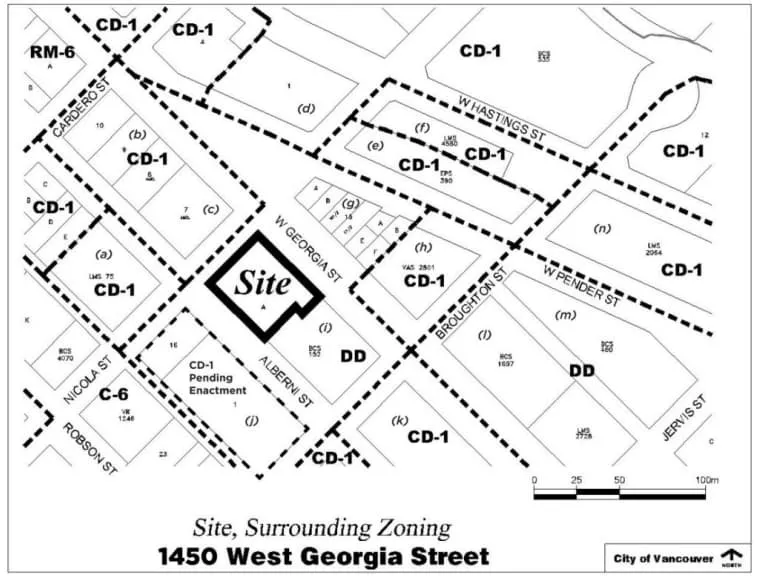
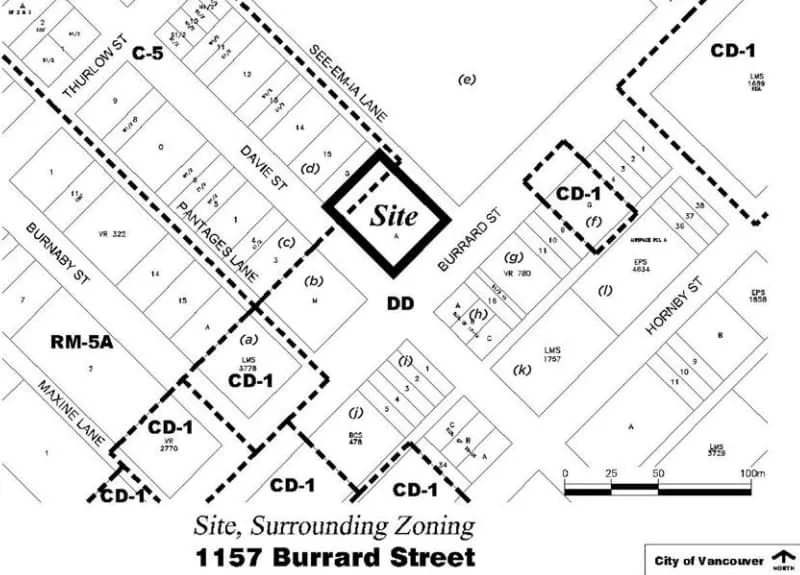
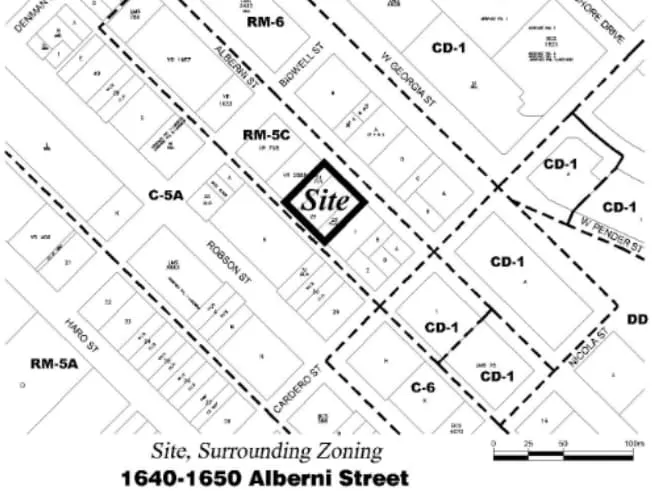
Apologies, for some reason, corporate email is not working, or corporate internet is not working. So just to give you an overview, this is probably the second or third time this council has probably seen this presentation and these matters before you. My name is Templar Sang Tranistis, Director of the Rezoning Center, and I'll walk you through the slides. Next slide, please. So this is a report to consider modifications to conditions of approval relating to the enactment timelines for CACs, or as it relates to the CACs. For these four projects, two on Alberni, one on West Georgia, and one on Burrard Street. Addresses and their locations are located on the screen there. Three are located in the West Georgia corridor and one in the Burrard corridor within the West End plan. Next slide, please.
The first project, and I'll walk you through each one just to give you some historical context, was approved at a public hearing in October 12, 2021. It's a 49-story mixed-use residential strata rental building with 193 units, 162 market rental units, and commercial space at grade. Next slide, please. This project came with a cash CAC contribution of $8.9 million, as well as DCLs as established at the time of public hearing. They would be subject to change on whatever the DCLs are at building permit stage. This is a bit of a snapshot back to 2021, including public art. So a total contribution, including CACs, DCLs, and public art of $17.4 million. The CAC cash contribution, which is the subject of today's meeting and I won't repeat it every time, was payable within two years. It was a condition to enact within two years of the public hearing and payment of those funds prior to enactment. That project deadline was extended to 2024 and then again in 2024 to May 2026.
The second project is 1157 Broad Street. It was approved in public hearing in fall 2021 as well. 47-story mixed-use building, 13 FSR, predominantly strata residential units, including a child care and an arts and culture hub within the building. Next slide, please. In addition to that, there was a cash contribution of $10.6 million in addition to the in-kind amenities at the time valued at $22 million, DCLs of about $8 million plus public art for a total public benefit of $41 million. Similarly, this project had those same conditions for requirements to enact. Next slide, please. Third project is 1640 to 1650 Alberni, again approved in public hearing in fall 2021. It includes a 43-story predominantly residential strata-titled building with replacement residential units for the removal of the existing rental building on site as well. Next one. And again, this one, in addition to the rental replacement units, came with a $32.7 million cash CAC.
Next slide, please. Last one here is 1666-1684 Alberni. It was approved at a public hearing in May 2022. It's a 40-story strata residential building, and it has been extended from its enactment timeline from May 2024 to May 2026 as well. Next slide. Thanks. And this one, too, came with a substantial cash CAC of $37 million payable prior to enactment.
Next slide. So here, just to summarize, the conditions of enactment at the time and as amended, their public hearings were all in 2021 or 2022. They originally had enactment deadlines in 2023, 2024. They've been extended to May 2026. And we're now on the cusp of that timeline seeking your direction around extension or modifications to the conditions of approval. Next slide. Just as some context, it's important to acknowledge the city's role in the development process. The city has the most control over established city policies and approval processes, whether that's through rezoning or development permits. Staff work with the applicants, timing expectations to advance the project through enactment in the permitting. And following approval, there's many aspects that affect the project beyond our control, such as funding, financing, interest rates, construction costs, supply and labor and trade availability, as well as general market capacity. And staff, and as you've all known, there's been a significant downturn in the strata market over the last several years. Staff have been in contact with the representatives over the past two years. There's been little progress since that time, again, just because of the slowdown in the strata market. And we're now at this point where we have to make a decision to continue with the conditions of approval as they've been set. I think there is a desire to proceed on the part of the applicants, provided there was a market for them to pursue as well.
Next slide, please. So our staff's recommendation today is to seek further modifications to the performance obligation on securing the enactment of the bylaws for an additional two years. We've been working closely, as I mentioned, together with them. Some of them have expressed an interest to revisit their projects over time. But in the absence of that, the interim step would be to extend those deadlines as well. we think that this is a consistent move from past decisions of council to grant these further extensions while still securing the approval in principle and the CACs that were agreed to at the time.
Thank you. So just as a quick recap, where do CACs go if there's some questions on that? Cash CACs are not allocated in the capital plan until they're actually received, so until enactment. So until we receive the monies, they aren't actually deployed into the capital plan. But once they are received, they go to support many of those capital plan improvements in both the West End and the downtown. And this just gives you a bit of a snapshot of where we get those monies from. This is the 2022 to 2026 capital plan. A portion of that is obviously from property taxes, but about half of it, close to it, is from development-related contributions such as DCLs, CACs, density bonusing, and the like. So today is not a decision about where do we put the money, it's more about keeping the project active through these conditions of approval that in the event that they do enact and pursue, that we would be able to secure these monies and ultimately deploy them. Last slide. So the consideration is, so again, just to clarify, we did include a consideration that you can refer these projects back to staff to revisit any of the terms of the project, but our recommendation on the last slide is for the extension of those deadlines from May 2026 to May 2028. If you go to the last slide, please. Thank you.
I'll just pause there if there's any questions. Thank you very much. Counsel, you do have up to five minutes to ask questions of team members. Counselor Orr.
Thanks. Thanks for the presentation. It helped answer a couple of things. Considering that the sort of strata market is cool right now, if we were to force them to sort of pay the CACs now, this risks sort of stopping the project.
Yeah, fair question. So technically, enactment is really at the discretion of the applicant to pursue the project. If they do enact, those obligations are payable. The way the conditions are worded is it's not an obligation to pay. It's a trigger to compel or to help encourage a project to move forward if there's a market to do so. So again, this condition basically holds that value, holds that rate based on the values established at the public hearing date back in 2021. if they choose to pursue this project in the future.
So essentially, if we were to say, no, you need to pay this now, this would sort of force them to be in a position to kind of proceed with the project.
Again, we aren't able to proceed them technically, force them to proceed. I would say if there was a direction to thou shalt pay this and thou shalt enact, that would be a very unique approach. We don't typically do that. And I could certainly see an applicant just being unwilling to do so.
I think that kind of answers my question. If we were to introduce a sunset clause, essentially, if the developer receives a deferral of the CACs but then fails to start within 24 months, the rezoning permit should expire. Is that something that...
Yeah, so this is from a bit of a pilot of how we explored some CAC terms back in 2021-2022. So this basically is a requirement to enact within two years and to secure that approval in principle. We've granted an extension. So that over time, these projects are also eligible for the deferred CAC policies. So if they were to enact, only the first $5 million is payable prior to enactment. And then beyond that, they're allowed deferral terms up to two years post-enactment. So, for example, the one project had $32 million. $5 million would have to be payable prior to enactment. $27 million could be deferred up to two years beyond enactment. But we can't compel the first $5 million initially without them enacting.
I see. Interesting. Okay. Just that I'm like seeing, you know, there's a project that's on today's agenda that's 1745 West 8th. You know, this project is a strata project and it's offering social housing and a child care. And this doesn't seem to be offering those public benefits and we're deferring the CACs.
So... Is this a sort of situation because the land there is just so valuable that we can't sort of extract some public benefits out of that?
Yeah, and I'll speak generally to the one on West 8th. That's an in-kind project and won't speak to the merits of it. That'll save that for future council decision. This area of the West End plan along the Georgia corridor in particular sought to seek cash to be able to deploy cash to other projects, whether it's the West End Community Center or other facilities in the area that need renewal and replacement or expansion. The project on Burrard did have inclusionary projects, so an in-kind childcare as well as the arts and space.
A cultural hub. So, again, it's more just how the West End plan was crafted for those areas to generate cash CACs to deploy to other facilities in the area. Okay. Thanks. That's enough for me. Thanks. Thanks, Councillor Meiszner.
Thanks. On the CACs themselves, what happens if these projects change? Let's say they go from strata to rental or they become a hotel. does that mean that those CACs would have to be renegotiated from the start? They would disappear, essentially?
Effectively. So it depends on the degree of change. But if an applicant were to come in with a different project, that would trigger a withdrawal, resubmit, and you restart the clock in the negotiation based on the merits of that project. If an applicant came in to completely change their tenure and form and other things, that CAC proposal that you see would be rescinded, and then you'd be presented with a new public benefit depending on what that new offer was.
Okay. Are staff aware of any... changes coming forth on any of those projects?
We've had inquiries from the applicants, the representatives of the project to explore, but no submissions, no applications yet.
Okay. And then on the proposed latest enactment date of May 31st, 2028, I guess my question is, if it was May 31st, 2028 right now, would your recommendation be the same for another further extension?
Fair question. And so this is, I think, the second or third time we've proposed the extension. What it's really doing is protecting the upset limit of the valuation to that date. It was always there intended to encourage projects to proceed and to take advantage of those rates. At the time, they were... than earlier negotiated rates in terms of valuation. So I think we would have to assess what it would look like in May 2028 if the market has returned, if the interest rates are still challenging, and have to reserve our comments for that point.
Okay, I understand.
Okay, thank you. Next. Counselor Zhou.
Yeah, thanks, Mayor. So a quick question. I might be wrong, but I remember one last time we granted this extension was the interest was prime plus 2%. Was that right? Or it was always 1%?
So again, to decouple the two, until enactment, there is no interest applied, right? So enactment is when the rights and entitlements of the rezoning are secured. And at that point, we trigger the CAC. We only have deferral terms with interest beyond enactment until the payment of the deferred cash. So right now, the new CAC policy is prime plus one as established from June 2025 when council made some modifications. So if these applicants did pursue the deferral, which I expect they probably would be interested, they'd have to pay $5 million prior to enactment, and then the balance would be deferred, and that deferral balance would be subject to interest occurring on a quarterly basis as well.
So last time when we did the extension, that was in 2024, I think?
Correct.
That's plus 2% at that time, right?
Again, to decouple the two, we aren't adjusting the value of the CAC as secured at public hearing today. It's only if they enact and then defer the balance. So we don't have an escalation clause between public hearing and enactment. It's only post-enactment.
Okay, other questions. This is a two-year extension, so if they are able to proceed the project, let's say if the marketing is getting better, let's say next year, they can still do that, right? Correct. We can do the extension.
Correct. All the projects have development permits in the system. Most of them have got most of their agreements and conditions cleared. It would be a bit of a reactivation of the file and pick things up, but I think if the market was there and there was a willingness, they have the full ability to proceed.
The last question is, do we have any regulation to see what is the maximum number of extension they can do?
That's really up to this council. The way the conditions are worded is really at your discretion to rescind, revisit, or extend the approval and staff are suggesting two-year increments just to see how the market conditions go, but it could certainly be a different timeline. Perfect, thanks. That's all my questions. Thanks, Mayor. Councillor Maloney.
Thank you. I've had a couple of inquiries about what the implications are for public infrastructure delivery timelines in the West End as a result of this. Can you explain how it works?
Yeah, sure. So effectively, rezonings and CAC contributions are one of the tools that we secure monies or in-kind facilities to help contribute to support growth in the community. Though we might forecast and anticipate projects to proceed, we actually don't use that from a budgeting perspective or a cost allocation perspective in the capital plan until they're received. So until that money is paid, it wouldn't show up in a capital plan as being funds available. We certainly have a forecast of where it could come in, but until that time, in the absence of those monies being paid, we're relying on other funding sources, whether it's DCLCAC's taxes or whatnot, to support the capital plan.
And there's not necessarily a connection between money that's paid for community amenity contributions and the area in which the development takes place?
Fair question. So CECs, from a policy perspective, are intended to support and offset the impacts of growth on the community that they're within. So our current CEC policy and the public benefit strategy for the West End contemplate that money being spent there, but it's certainly within Council's purview as part of your PIF exercise, the Public Infrastructure Investment Framework and our Capital Plan Framework, as well as your city policies to determine how and where that money is ultimately deployed to.
Thanks. And what does happen if market conditions are still weak in 2028?
At that point, if the project isn't proceeding and we're kind of at the new due date of May 2028, the council has the option again to extend or to rescind or to revisit this at a public hearing as well. And between now and then, I'm sure we'll have more conversations with the applicants of what their intentions are. Thanks very much. Thank you, Councillor Kirby-Young.
Yeah, just following up on a question that was asked earlier, and I think it was phrased that some of the other projects were delivering community amenities or in kind of this was not. Is the cash or the tens of millions of dollars of cash not a public benefit? It's just taken as cash versus in kind? Correct.
Yeah, that's correct.
And we're talking about if I added up something like $110 million conceptually?
Close to that, yeah.
Okay. Which can do a lot for community amenities. And if these projects, if we don't create the conditions because the market is tough for these projects to move ahead and they don't build, we get zero to support community amenities and we don't get the housing if they can't make it go. I'll go with it. Is that fair?
I think we're, as I mentioned before, there was a slide in there that showed the different levers that might affect development. The city is one of them, and so are our policies. And the city has done a good job in both June, last year, and December, this past year as well, with development viability reports, cutting back on DCLs, being flexible on some of the unit layouts and the exclusions that are being explored, the BMR modifications while we're rental. So those are the kinds of things that the city has done and continues to do to help encourage projects moving forward. I would say this area of the downtown and the west end is a high-end strata particularly, and that market is all but evaporated in the short term.
So reflecting back then, is it fair to say the city is changing a number of our levers to try to do what we can, but the market conditions may or may not recover to allow these projects to proceed?
That's a fair statement.
Thank you.
Thank you very much. Okay, seeing no... Councillor Montague.
Oh. We have gremlins. Okay. Would someone like to move a motion? Great. Councillor Zhou, I believe. Councillor Claston is seconded. Council, is there any discussion? Okay.
Statement Watch
Apologies, for some reason, corporate email is not working, or corporate internet is not working. So just to give you an overview, this is probably the second or third time this council has probably seen this presentation and these matters before you. My name is Templar Sang Tranistis, Director of the Rezoning Center, and I'll walk you through the slides. Next slide, please. So this is a report to consider modifications to conditions of approval relating to the enactment timelines for CACs, or as it relates to the CACs. For these four projects, two on Alberni, one on West Georgia, and one on Burrard Street. Addresses and their locations are located on the screen there. Three are located in the West Georgia corridor and one in the Burrard corridor within the West End plan. Next slide, please. The first project, and I'll walk you through each one just to give you some historical context, was approved at a public hearing in October 12, 2021. It's a 49-story mixed-use residential strata rental building with 193 units, 162 market rental units, and commercial space at grade. Next slide, please. This project came with a cash CAC contribution of $8.9 million, as well as DCLs as established at the time of public hearing. They would be subject to change on whatever the DCLs are at building permit stage. This is a bit of a snapshot back to 2021, including public art. So a total contribution, including CACs, DCLs, and public art of $17.4 million. The CAC cash contribution, which is the subject of today's meeting and I won't repeat it every time, was payable within two years. It was a condition to enact within two years of the public hearing and payment of those funds prior to enactment. That project deadline was extended to 2024 and then again in 2024 to May 2026.
Next slide, please.
The second project is 1157 Broad Street. It was approved in public hearing in fall 2021 as well. 47-story mixed-use building, 13 FSR, predominantly strata residential units, including a child care and an arts and culture hub within the building. Next slide, please. In addition to that, there was a cash contribution of $10.6 million in addition to the in-kind amenities at the time valued at $22 million, DCLs of about $8 million plus public art for a total public benefit of $41 million. Similarly, this project had those same conditions for requirements to enact. Next slide, please. Third project is 1640 to 1650 Alberni, again approved in public hearing in fall 2021. It includes a 43-story predominantly residential strata-titled building with replacement residential units for the removal of the existing rental building on site as well. Next one. And again, this one, in addition to the rental replacement units, came with a $32.7 million cash CAC. Next slide, please. Last one here is 1666-1684 Alberni. It was approved at a public hearing in May 2022. It's a 40-story strata residential building, and it has been extended from its enactment timeline from May 2024 to May 2026 as well. Next slide. Thanks. And this one, too, came with a substantial cash CAC of $37 million payable prior to enactment. Next slide. So here, just to summarize, the conditions of enactment at the time and as amended, their public hearings were all in 2021 or 2022. They originally had enactment deadlines in 2023, 2024. They've been extended to May 2026. And we're now on the cusp of that timeline seeking your direction around extension or modifications to the conditions of approval. Next slide. Just as some context, it's important to acknowledge the city's role in the development process. The city has the most control over established city policies and approval processes, whether that's through rezoning or development permits. Staff work with the applicants, timing expectations to advance the project through enactment in the permitting. And following approval, there's many aspects that affect the project beyond our control, such as funding, financing, interest rates, construction costs, supply and labor and trade availability, as well as general market capacity. And staff, and as you've all known, there's been a significant downturn in the strata market over the last several years. Staff have been in contact with the representatives over the past two years. There's been little progress since that time, again, just because of the slowdown in the strata market. And we're now at this point where we have to make a decision to continue with the conditions of approval as they've been set. I think there is a desire to proceed on the part of the applicants, provided there was a market for them to pursue as well.
Next slide, please. So our staff's recommendation today is to seek further modifications to the performance obligation on securing the enactment of the bylaws for an additional two years. We've been working closely, as I mentioned, together with them. Some of them have expressed an interest to revisit their projects over time. But in the absence of that, the interim step would be to extend those deadlines as well. we think that this is a consistent move from past decisions of council to grant these further extensions while still securing the approval in principle and the CACs that were agreed to at the time. Thank you. So just as a quick recap, where do CACs go if there's some questions on that? Cash CACs are not allocated in the capital plan until they're actually received, so until enactment. So until we receive the monies, they aren't actually deployed into the capital plan. But once they are received, they go to support many of those capital plan improvements in both the West End and the downtown. And this just gives you a bit of a snapshot of where we get those monies from. This is the 2022 to 2026 capital plan. A portion of that is obviously from property taxes, but about half of it, close to it, is from development-related contributions such as DCLs, CACs, density bonusing, and the like. So today is not a decision about where do we put the money, it's more about keeping the project active through these conditions of approval that in the event that they do enact and pursue, that we would be able to secure these monies and ultimately deploy them. Last slide. So the consideration is, so again, just to clarify, we did include a consideration that you can refer these projects back to staff to revisit any of the terms of the project, but our recommendation on the last slide is for the extension of those deadlines from May 2026 to May 2028. If you go to the last slide, please. Thank you. I'll just pause there if there's any questions. Thank you very much. Counsel, you do have up to five minutes to ask questions of team members. Counselor Orr.