Public Hearing
July 14–22, 2026
Sessions
Session 1 Tue, July 14, 2026 · 05:50 pm–10:00 pm Watch
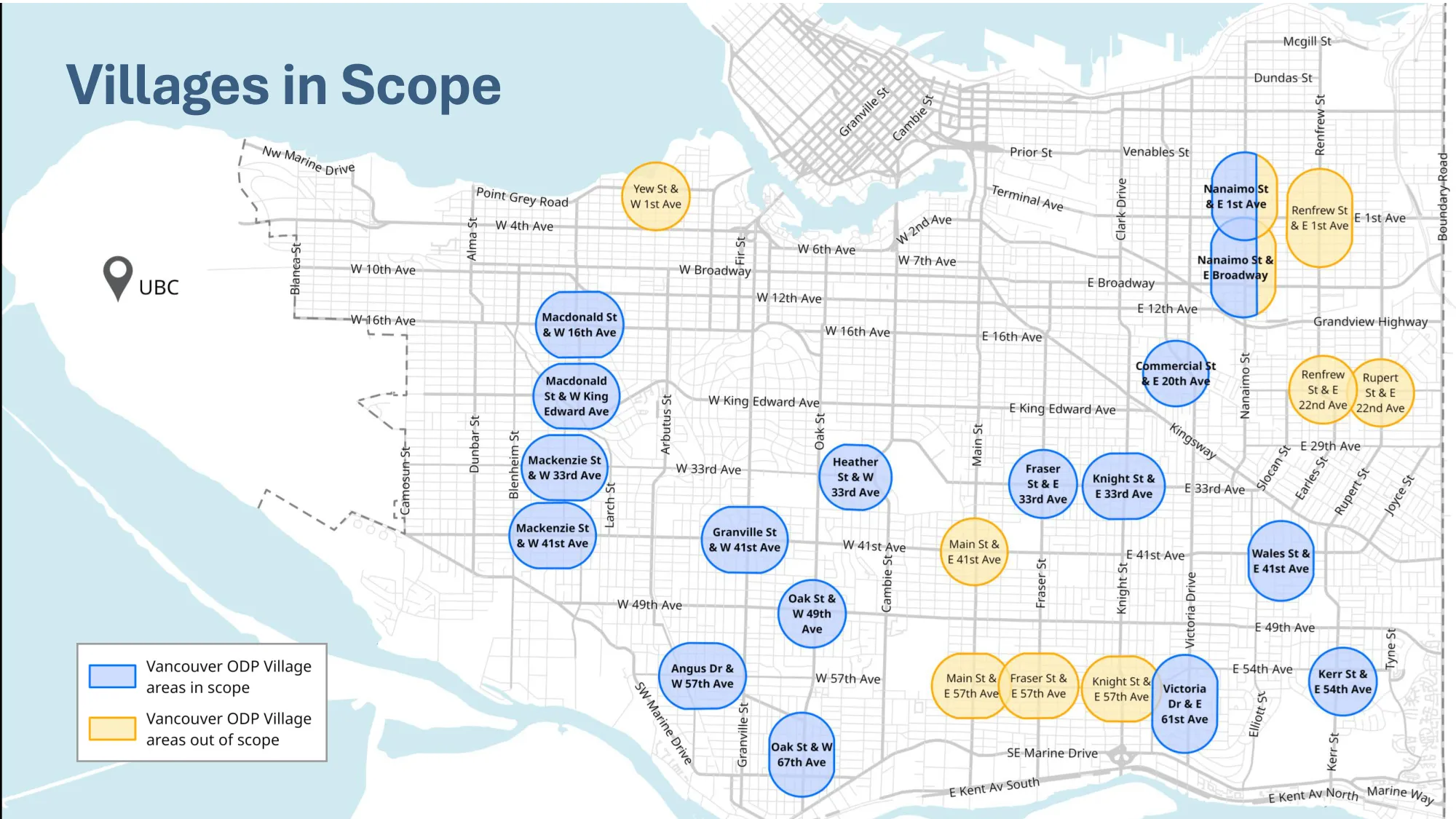
- Villages Planning Program (Recommendations A–K): carried. Council heard the full staff presentation and public testimony on a city-initiated rezoning of approximately 13,000 parcels across 17 village areas, along with amendments to the Vancouver Official Development Plan and Zoning and Development By-law. The public hearing recessed partway through the speakers list and will reconvene Monday, July 20, 2026 at 1 p.m.
- Staff presented the Villages Plan as the final outstanding commitment under Vancouver's Housing Accelerator Fund agreement with the federal government; failure to complete it could risk up to $15 million (50%) of a remaining $30 million draw.
- Key zoning changes proposed include new R3-4 and R3-1 residential low-rise districts, new C-2D and C-2E mixed-use districts, repeal of the RM-12 district schedule, and rezoning of 145 parcels in the Rupert and Renfrew Station Area Plan to C-2D.
- Inclusionary affordable housing requirements apply only on the west side (west of Ontario Street) and only to specific large-lot strata developments; east-side sites were found financially unable to support such requirements without deterring development.
- Staff acknowledged concerns from a small number of property owners in proposed retail expansion areas (approximately 4% of affected parcels, roughly 700 lots) who would lose the ability to redevelop as single-family homes or multiplexes; staff signalled possible amendments including replacing city-initiated C-2 rezoning with a rezoning policy for those areas.
- Space-efficient (single-egress stair) building options, previously directed by council, are being implemented through this plan as changes to the R3 district schedules citywide.
- Correspondence received: 317 in support, 1,771 in opposition, 48 on other aspects.
- Public speakers were split; supporters cited housing affordability, missing middle supply, and demographic inclusion; opponents cited inadequate consultation, tree canopy loss, property rights restrictions, retail oversaturation, and concerns about displacement of existing residents and businesses.
Session 2 Mon, July 20, 2026 · 01:00 pm–04:57 pm Watch
- The public hearing for the Villages Planning Program, Villages Plan, City and Nation Rezoning, and Vancouver Official Development Plan amendments reconvened from July 14, 2026; council continued hearing registered speakers, beginning at speaker 26.
- The vast majority of speakers opposed the plan; common themes included the freezing of roughly 600 to 750 properties under C2D retail zoning (barring owners from renovating, adding laneway homes, or rebuilding), the absence of enforceable affordability requirements, potential property tax increases from upzoning, loss of mature tree canopy, inadequate infrastructure planning (schools, transit, parks, community centres), and concerns that new retail nodes would undercut struggling existing commercial streets.
- Several speakers with professional backgrounds in planning, medicine, architecture, and public policy argued the plan lacks an evidence base, relies on unproven assumptions about density producing affordability, and was developed without meaningful community consultation.
- One speaker, a registered professional planner, spoke broadly in support of the plan's framework but urged council to add an explicit land-acquisition policy for non-market housing before approving it.
- Business representatives, including the Kerrisdale Business Association, opposed the plan on grounds that new commercial zones would compete with and weaken existing BIA areas.
- An MLA representing a riding containing seven of the proposed villages appeared in person to relay constituent opposition, particularly regarding the property freeze and the mid-summer timing of the hearing.
- The hearing was recessed at the end of the session and will resume Wednesday, July 22, 2026 at 9:30 a.m. in council chambers.
Session 3 Wed, July 22, 2026 · 09:30 am–11:00 pm Watch
No summary for this session yet.
Session 4 Wed, July 22, 2026 · 11:05 pm–12:00 am Watch
- The Villages Planning Program (Recommendations A through K) was the sole substantive item, covering rezoning changes across 17 designated neighbourhood commercial village areas citywide.
- Public hearing ran well past midnight, with speakers spanning local residents, renters, workers commuting from outside Vancouver, and at least one caller from California; procedural issues arose around speaker identification, live-stream continuity, and the phone system resetting at midnight.
- Supporters argued the plan addresses a severe housing shortage, that single-family zoning has exclusionary roots, and that increased supply is already demonstrably lowering rents in Vancouver.
- Opponents raised concerns about infrastructure capacity (water, sewer, schools, transit, sidewalks) not being confirmed before rezoning takes effect; loss of laneway and townhouse options; inadequate community consultation; and the absence of clear, measurable affordability targets.
- Several speakers called for a phased approach, starting with pilot villages, establishing binding affordability benchmarks, and reporting publicly on outcomes before citywide rollout.
- Questions were raised during the hearing about whether Vancouver had already met its Housing Accelerator Fund supply targets, and whether the full Villages Program was therefore required under that federal agreement.
- Procedural notes: the live stream temporarily appeared to drop late in the session; councillors were reminded that the phone registration system resets at midnight and the online viewing link would also change after that point.
From official documents
- The Villages Planning Program, a major city-wide planning initiative, was the sole agenda item at this Public Hearing.
- The program proposes 17 new "village" areas across Vancouver, each centred on a walkable high street with shops and services within roughly a 5-minute walk of residents.
- About 13,260 parcels across the city were subject to city-initiated rezoning, allowing buildings up to six storeys with ground-floor commercial uses on high streets, and low-rise residential buildings in surrounding areas, without requiring individual rezoning applications.
- New zoning districts were created (R3-4, C-2D, C-2E) and the RM-12 district was repealed; associated by-laws including the Zoning and Development By-law, Sign By-law, Noise Control By-law, Subdivision By-law, Parking By-law, and the Vancouver Official Development Plan were all amended to align with the new program.
- Amendments to existing community plans (including the Norquay Village, Grandview-Woodland, Marpole, Cambie Corridor, and Rupert and Renfrew Station Area plans) were approved in principle to remove duplication with the new Villages Plan.
- A large volume of public correspondence was received both supporting and opposing the plan; supporters cited the need for more housing choice, walkable neighbourhoods, and "missing middle" density, while opponents raised concerns about consultation adequacy, neighbourhood character, infrastructure capacity, property tax impacts, and the pace of change.
- All recommendations (A through K) carried.
Motions
Villages Planning Program – Recommendations A through K
Carried Details
- Proposes rezoning approximately 13,000 parcels across 17 neighbourhood village centres to allow up to six-storey mixed-use development, with retail at grade and provisions for below-market and non-market housing.
- Replaces as-of-right permissions for single-family homes, laneways, and townhouses in the designated core areas with higher-density residential and commercial forms.
- Supporters contended the plan corrects decades of exclusionary zoning, creates missing-middle and rental housing, and is consistent with evidence from other cities that gentle density reduces rents and increases walkability.
- Opponents argued infrastructure upgrades (sewer, water, fire flow, schools, childcare, transit, sidewalks) should be confirmed and funded before rezoning grants new capacity, not confirmed project-by-project after the fact.
- Critics also called for clearer affordability outcome measures, displacement monitoring, construction management plans for simultaneous redevelopment, and a phased rollout beginning with willing pilot neighbourhoods rather than all 17 villages at once.
- Concerns were raised that the plan eliminates laneway and townhouse options that some homeowners were counting on for multigenerational living, and that property tax assessments based on new highest-and-best-use zoning could force long-term residents out.
Agenda documents (15)
ROLL CALL
1. Villages Planning Program – Villages Plan, City-initiated Rezoning and Vancouver Official Development Plan Amendments
- Summary and Recommendations – Villages Planning Program – Villages Plan, City-initiated Rezoning and Vancouver Official Development Plan Amendments
- Referral Report revised on June 30, 2026
- Superseded Appendices B and H from the Referral Report on June 2, 2026
- Draft Vancouver Official Development Plan By-law to implement the Villages Planning Program
- Draft Vancouver Official Development Plan By-law to clarify consistency with the GLU
- Draft Vancouver Official Development Plan By-law regarding Villages Planning Program
- Draft Zoning and Development By-law
- Draft Sign By-law
- Draft Subdivision By-law
- Draft Noise Control By-law
- Draft Parking By-law
- Memorandum from the General Manager, Planning, Urban Design and Sustainability dated June 23, 2026
- Yellow Memorandum from the General Manager, Planning, Urban Design and Sustainability dated June 30, 2026
- Staff Presentation
- Download the agenda