Heather Lands CD-1 Rezoning Approval
Motion 12 · Council Meeting, March 31, 2026
Summary
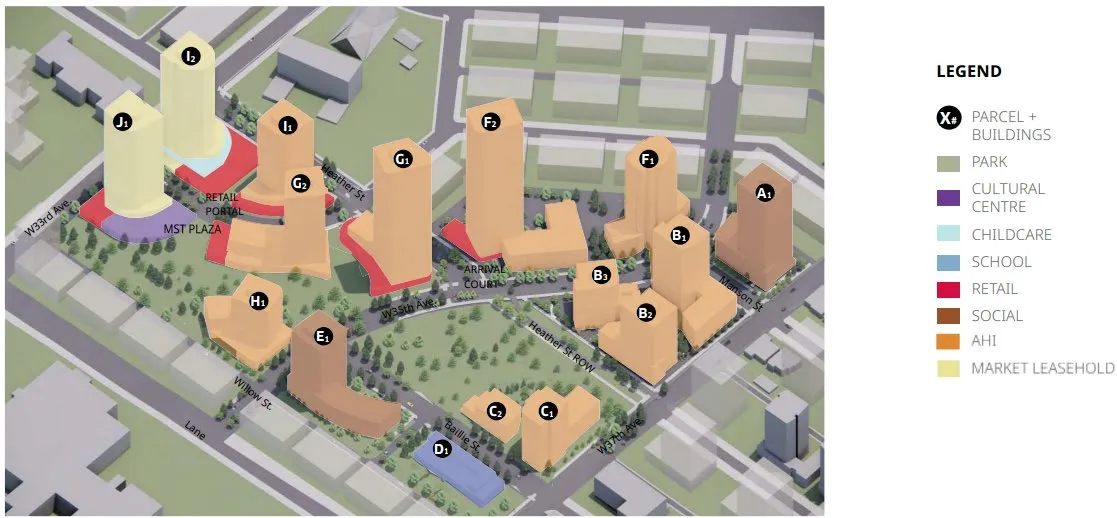
- Council approved the rezoning of the Heather Lands site (approximately 8.5 hectares near Heather Street and West 37th Avenue) from existing CD-1 zoning to two new Comprehensive Development zones — CD-1 South and CD-1 North — enabling a large, phased mixed-use development.
- The project is a joint venture between the Musqueam Indian Band, Squamish Nation, and Tsleil-Waututh Nation (collectively the "local Nations") and Canada Lands Company, and is considered a significant step in the City's reconciliation efforts.
- The proposed development would include approximately 610 units of social housing, 700 leasehold strata units, and 2,940 Attainable Housing Initiative (AHI) units (discounted leasehold strata), along with commercial, community, and cultural spaces.
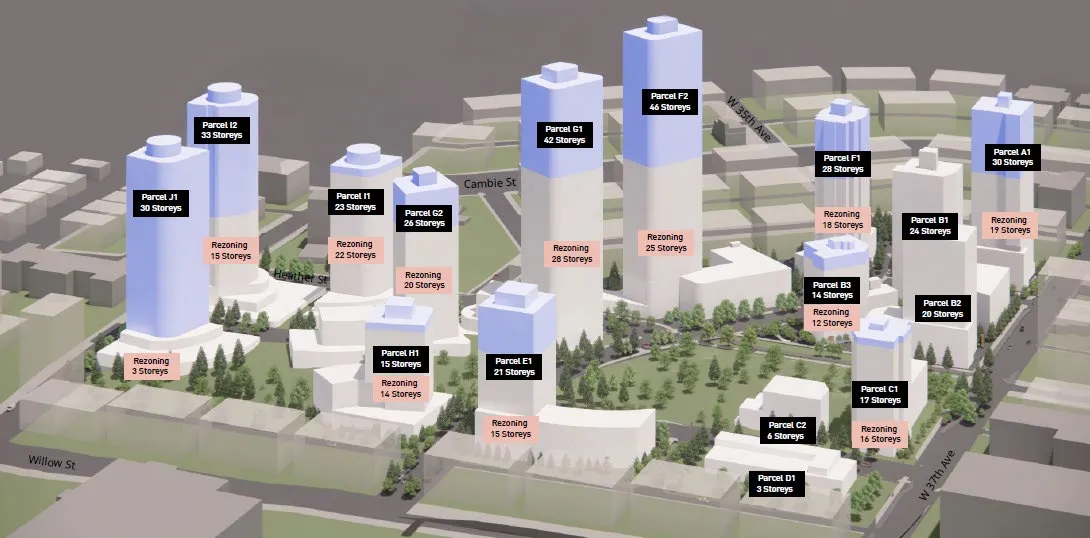
- Buildings would range from 4 to 46 storeys, with a combined gross floor area of approximately 317,861 sq. m (3.4 million sq. ft.), designed by GBL Architects.
- Two separate CD-1 by-laws and housing agreements are required — one for each zone — to allow phased enactment and build-out of the development over time.
- Associated amendments to the Sign By-law, Noise Control By-law, and Heather Lands Design Guidelines are also part of the approval package.
Report Images

Vote
Transcript
191 segments
Yeah, thanks, Mayor. I do have some questions, and I'm not sure, maybe just procedurally, because I probably have more than five minutes of questions, so if you could pause my time. Is there a way to enable questions or more than five minutes of questions? Clerk's comment on that?
Councillor council may move for a second round.
Okay. Thank you I want to, and I can only ask questions of staff at this point, but could you walk me through, there was questions asked during the public hearing around the previous rezoning application that was approved in 2022. And this is obviously a modified application. Does that application, what was approved in 2022 still stand despite this application?
Good morning, Mayor and Council.
Is the rezoning decision?
Yeah. Good morning, Mayor and Council. Matt Shilito, Director of the Special Projects in PDS. That's right. There was a previous rezoning in 2022. The rezoning area is divided into two CD1 bylaws. One of those, which we call CD1 South, was subsequently enacted by Council and currently stands. The other one, CD1 North, was retracted by the applicant through this new rezoning application process. So currently... the enacted CD1 by-law south stands and would only be superseded by council's approval and ultimate enactment of this subsequent rezoning.
So one of my colleagues was asking during public hearing about the previously approved heights and densities. Were they applicable to both the CD1 sites? Could you walk me through that in the context of the new application? Because what I've heard is that the South CD1 site stands, and maybe I'm not clear whether the new application now covers both CD1 sites. So maybe you could walk through that. And I'm referring to Councillor Meiszner's question that he asked during public hearing.
YEAH, SURE. SO YES, THIS NEW APPLICATION BEFORE COUNCIL TODAY COVERS BOTH CD1 AREAS, THE WHOLE SITE, AND THE ADJUSTED HEIGHTS, THE INCREASED HEIGHTS AND DENSITIES ACROSS THE SITE ARE APPLIED ACROSS BOTH CD1 AREAS.
Okay. The memo that was circulated to council on March 26, 2020, sorry, March 26, 2026, referred to a legal agreement in place between the province and MST, and I understand it's the ministry leading the work around the attainable housing initiative. Could you comment on The level of line of sight we have into that legal agreement and commitment from the province around the funding, I understand, I think it was 100 million has flowed already. But can you give me some better understanding of what line of sight we have into that agreement?
Yes, certainly, and you're correct. There is a legal agreement in place between the ministry and the MST partnership. We, the city, are not party or privy to all of the details of that agreement, but the applicant and the province have both shared information with us through the application process. And the gist of it is that the province has agreed to... contribute $476 million in funding towards construction of the Attainable Home Ownership Initiative units, the AHI units. And of that $476 million, $105 million has already been paid and is now indeed being spent on early construction works on the site. As part of the memo we provided, we included a letter from the province reaffirming their commitment to executing that legal agreement with the MST partnership and indeed referenced the provincial budget for 2026 and 2027, which makes reference to the Attainable Home Ownership Initiative.
So it sounds like what's been disclosed is the financial commitments. Were staff, are staff privy to other assumptions in that agreement around if the province is unable to fund this initiative? Or do we have access to that information of what agreements have been reached between MST and the province?
No, we have no line of sight on the matters in the legal agreement relating to what happens if the province doesn't fund the AHI units. What I would say, though, is that we have structured the proposed rezoning to include a scenario under which the attainable home ownership initiative ceases. And in that case, we would invoke what we've called the non-AHI scenario in the zoning bylaws and the housing agreements. and that would require an alternative housing tenure mix of a minimum of 15% rental, of which 25% is below market rental, and holding the social housing requirement, which is 14% constant. So we've essentially put in a plan B in the event that the AHI program ceases at some point through the build-out of the project.
In that vein, given that...
Okay, hopefully someone can move a second round, because I have more questions.
Sorry, I need a mic. Thanks. I'm going to follow up on this. And this is an unusual one. I'm just going to preface my question by saying we're getting a lot of... feedback from the public for better understanding around how some of these deals are structured and more clarity and transparency. So you referenced the contribution agreement with the province and the letter there that confirms that. Am I correct in understanding that the letter indicates only an intention to execute the contribution agreement for 2026-2027 or the one year and the approved $105 million, but we don't necessarily have a commitment for the province's remaining several hundred million dollars. It will take a billion dollars of funding between provincial contributions and what the partnership is required to raise there is no commitment from the province is that correct in writing at this point for the balance of the funding required to achieve the aho is that correct and so so um just to be clear that the 476 million dollars in funding is sufficient to achieve the full attainable home ownership package on this project i understand that but has the province has not signed on a dotted line to say they will commit that full amount nor is it in a budget is that correct um
All the information we have on that is contained in the memo, so there's a letter from the Ministry.
Okay, so that's how I read the memo. I guess, do we have the ability to provide more transparency and have access to this agreement? Because I ask this question in the context that Council is being asked to advance a significant 30% increase in density on the site without a line of sight into how the certainty of that funding and how and when it will be advanced.
Well, certainly council could, you know, in their discretion, pass the motion seeking further information on that financial agreement. Yep.
We could seek it, but we don't have it and we can't necessarily compel it.
That's correct.
Okay, you mentioned a non-AHI scenario reverting to 15% rental, but it still retains, with some BMR, it still retains a 30% increase in density on what was already a very highly dense site. Why would the non-AHI scenario, if it's not affordable home ownership, not revert to the existing approved entitlements on the site?
Yes, thank you. So in coming up with a non-AHI scenario, we looked at a bunch of different possible tenure mixes that could be supported in the context of the additional density.
Can I clarify in the context of the additional density? Yep. If the primary driver and the goal, and I think people are excited about the idea of affordable or attainable home ownership, and if that is the driver and if that's not achieved, why did we look at other scenarios other than the existing... Pretty substantive rezoning that was passed if the AHI cannot be achieved, if that was the primary goal.
Well, certainly delivering the AHI is the primary goal. But as I mentioned, given the innovative nature of the AHI program and the long-term build-out of the project, we were asked by the applicant to include a Plan B, an alternative non-AHI scenario. And we looked at what the project might be able to deliver, including the additional density, and concluded that the 15% rental minimum with 25% BMR and the social housing and the other public benefits in the project were a reasonable outcome, an acceptable outcome in terms of the financial performance of the project.
Okay. I'm just going to keep going for time because, as you know, we're limited for time.
Why, if there's two different parcels or rezoning processes, why was the previous entitlements withdrawn for one component and not for both? This is very unusual, and I can't recall something like this in my time on council, and I think back to things like Oak Ridge and other large development areas that come forward for text amendments. Why was one withdrawn and not the other, where the entitlements would remain for one and not the other piece?
Yeah, the difference is that the CD1 South has already been enacted by council, so it can only be replaced by a newly enacted rezoning on that site. The CD1 North, the other one which was removed, was retracted, was retracted because we had another application in play and we can't work with two applications on the same site because the one on the North had only been approved in principle by council and not yet enacted, so therefore was not in place.
So scenarios typically council in a rezoning can either approve, not approve, or add conditions. I've been told we can't add conditions by staff to revert to the previous zoning. What other options do we have? Can we take a pause on this one to get some of the information so there's more clarity and transparency about the pathway to fully achieving DHI?
Council could do that. Could seek, for example, to apply a condition asking for more information on those things, either prior to making an approval in principle or after making an approval in principle today and prior to enactment. Those are both options available.
I'm sorry, we're out of time. But we will have a second round. Councillor Meiszner?
Yeah, thanks, Mayor. Following a similar line of questions, Following up on Councillor Kirby-Young's question around the tenure, if the AHI scenario is not achieved, what is staff's rationale for going to an 85% strata scenario with no affordable housing opportunities for purchase if AHI is not achieved, given the 30% increase in density? Why not do 100% rental, for example, with 20% BMR? Why move forward with 85% strata?
Yes. In fact, it wouldn't be 85% strata. So the non-AHI scenario would be, in round figures, 15% social housing. It's a little over 14%. 15% rental, of which 25% is BMR. And the balance, 70%, would be leasehold strata. And that mix across the board was reviewed in terms of the financial performance of the project and the ability of the project to deliver affordable housing in the absence of the Attainable Home Ownership Initiative funding, and found to be an acceptable, reasonable level of affordability in the context of what the project was delivering as a whole, even with the increased density that's...
Sorry about the error there with the social housing. So 70% strata, but no affordability component in the non-AHI scenario, right?
Correct.
Okay. That strikes me as unusual. given the additional density that's being asked for here. I'm still struggling to understand why that would be. Looking at Broadway planned, for example, much smaller towers, much less density, still 20% BMR.
Yeah, in fact, the non-AHI scenario matches fairly closely to our sustainable large sites rezoning policy. That has a target of 20% social housing and 10% rental, again, of which a quarter is below market rentals. So that was one of the benchmarks we used when applying our work on this non-AHI scenario. So it's actually pretty close to the target that we have in that sustainable rezoning policy for these kinds of sites.
Okay, thank you for that. Back to the agreement. Is it fair to characterize this agreement, of which we don't have line of sight to, which is a concern, as more of a commitment than a guarantee? Looking at the letter from the minister, I don't see any number in there. I see 2627, but I don't see a guarantee.
Yeah, I think it's fair to describe the letter as a letter of commitment. And then what we're doing is combining that with the $476 million number, which we have been using as part of the applicant's application package to do all of the financial work here, and the $105 million that, as I say, has already been paid and is being spent currently in the works that are underway on the site. So that's really the, if you like, the totality of the commitment across what we know.
So just for the public who's not necessarily in government, doesn't necessarily understand how things work, if we have a change of provincial government, there's nothing to guarantee that commitment. It could go away.
It could. And again, given it's a long-term project, the AHI initiative is new, governments could change. Really, that's one of the motivations for the non-AHI scenario and coming up with a package that we think is a reasonable level of affordability across a site like this in context of the other public benefits that it's delivering.
Okay. And does that non-AHI package still include the reduction of the cultural center space, which I believe is being reduced by 50%?
That's correct. It does.
So the non-AHI version also includes a smaller cultural center as well, even though there's no AHI being delivered?
That's correct. So we looked in the non-AHI scenario at the financial performance of the project. ensuring maintaining the non-housing public benefits package, including the cultural center constant in both scenarios.
Okay, thank you. And then my last question for now was around the CD1 South. You said it's enacted and it stands. What portion of this overall development is that? Is that like 50% of it? Is it a different portion? In terms of, like, units?
In very round figures, 50%. We could give you the exact percentage.
Okay, so if they want to go ahead with that today, they have every right to go ahead with that previously enacted rezoning. Is that correct?
That is correct.
Okay, great. Thank you.
Thank you very much, Councillor Klassen. Thanks very much. Can I move to the second round? Thank you very much. Seconded by Councillor Zhou. Any discussion? All in favour? All opposed? Great. That passes unanimously. Please go ahead.
Thanks very much. So, Matt, to start off with a general question, as you know, council has already approved at least some staff direction around attainable home ownership. I think that work has been on a bit of a low burn with so much other work that's going on at the city right now. Is the city of Vancouver ready for the attainable home ownership model?
I might ask Dan Garrison from our housing team to answer that. Thank you. Hi, thanks. Councillor Dan Garrison, Housing Policy and Regulation. It depends on the model that's being structured. We are certainly working up based on council approval of the affordable or attainable homeownership policy and pilot program that council adopted recently. We're working that through with applicants and we will be working through with our legal team around the types of agreements that are required there. This is a little bit of a separate scenario where for this project, it's really being implemented largely through a provincial initiative. The majority of the administrative processes, all of the work that needs to be done around that would be carried by the provincial government and the MST partnership. So I'm not concerned about our administrative capacity to handle this attainable housing proposal.
Dan, I might ask you another question just because you've been closely attached to this file, this model. Does staff perceive that there's genuine public benefit in trying to create a more attainable type of ownership housing in the city?
absolutely and the proposal on the table here today is a very is quite a beneficial proposal should it be approved and should the province the provincial commitments fault flow through like we're talking about A two-bedroom unit, let's use an example, that would require a household income of well over $200,000 and a $200,000 down payment. Now being affordable to a household with a $30,000 down payment and affordable to a household with maybe $130,000 a year income. So that's a pretty substantial benefit. Monthly housing costs going from $5,000 a month to $3,000 a month. These are very substantial public benefits and aligning with even as deep affordability or a deep public benefit as some of our rental programs, but also allowing some of the benefits of ownership.
So it's a real acknowledgement of the challenging market conditions, both for development ownership housing, but also the market.
Yeah, I mean, we're talking about product that would be almost impossible for just an average resident to get into without significant equity built up or help from parents and that sort of thing.
I tend to feel that the public sentiment on this will split two ways. One, between people who are concerned around the heightened density, and then the others that will see this as potentially an opportunity for them to actually own a home in the city of Vancouver, which has been a far-off dream for, unfortunately, too many first-time buyers and young families. How long, this is a phased approach, how long do we perceive the opportunity will be in front of people to actually be able to own a home through AHI at Heatherlands? How long will it be until? Yeah, some of the first housing that might be built.
Yeah, I think we could see the first housing being built within approximately four years.
Okay. Okay, I'll pause there for now.
Thanks very much. Thank you. Great. Thank you very much. And just a reminder to Council, we are in debate. So I know there's a lot of focus on questions. We do have a second round, but just wanted to highlight that. If you get surprised after, if you're out of time and you have no time to debate, just wanted to flag that. Councillor Domenato.
Thanks. I just want to circle back to a couple of questions. It was addressed that there is a legal agreement. We don't have full access to the information in that legal agreement. We could seek more information. I heard that through a motion. What I'm curious about is that given that this proposal, which includes the seeking additional density and height to support the attainable home ownership initiative, is there a precedent for having an agreement between the city and the provincial government to reflect that?
I can't personally think of a comparable example. No.
Could we seek that?
To connect the density to the attainable home ownership initiative?
No, to get confirmation and alignment around the funding commitment. Because effectively, what I heard very clearly is part of this is to accommodate the builder in achieving the revenues necessary to develop this project. But at the same time, it's also subsidizing BC, not BC housing, the province. There's an agreement between MST and between the province, but there's no agreement between the city and the province for us to have an understanding and commitment that that funding will flow. Even an MOU, I guess, is what I'm getting at. Could we seek that?
We could, yes. Essentially, the city's role in this is to consider the proposal from the applicant and, you know, if approved, grant the density to enable the AHI program to proceed. We have no other role legally through an MOU or other kind of legal agreement with the province or the applicant, the developer on this project at this stage, but it's something that could be explored. Okay.
So we could seek more information about the existing legal agreement. We could seek some form of MOU or agreement with the province. My last question, because I don't want to run out of time for debate later, is the proposal, the application at Arbutus 7th and 8th was challenged in court because there was counsel referred to a document that was not accessible to the public as part of debate. And we got challenged on procedural fairness. Can you comment on that? And if we have to go in camera on this, I'm happy to do that. But that was a legal challenge we faced because of information not available to the public as part of a public hearing.
SO I CAN'T COMMENT ON THAT CASE. WHAT I CAN SAY IN THIS CASE IS THAT THE MATERIALS THAT HAVE BEEN BROUGHT FORWARD TO COUNCIL WERE IN THE APPLICATION DOCUMENTS. SINCE THE PUBLIC HEARING PAUSED ON MARCH 5TH, WE HAVE NOT SOUGHT ANY FURTHER INFORMATION FROM THE APPLICANT OR REQUIRED ANY NEW INFORMATION THAT WAS NOT PUBLIC. What we have simply done is approach the province to ask them to reaffirm their funding commitment to the AHI units, which they've done through the letter. So that's been the process to date on this application.
Okay. I'll pause there. Thank you.
Thank you, Mr. Klassen. Thanks very much, Mayor. I'm sort of generally sensing from the line of questions from council today that there's just a lot of just need for clarification around the certainty around the AHI. So I'm going to ask just... one or two more questions on that subject.
There is a over $100 million commitment from the province, which is not an insignificant sum, but of course it falls well short of the actual delivery. But we appreciate the financial situation that the province is in right now. What's their likely rate of return on that one? Is this going to be something that would be something that for both the development company and for the province that this makes financial sense so that as a carry forward, regardless of who is forming government in Victoria, that they see this that makes business sense?
Yeah, that's right. I mean, without getting into a specific rate of return, what I would characterize the provincial funding commitment to be is an investment in a project to deliver attainable home ownership, but also to grant a stake in the project, which... probably in all likelihood based on historic trends over the next 25 years the units would appreciate in value and then the province would recoup some of that value after 25 years or indeed before if the units are sold before that time and so I think it could be characterized as a very solid investment of capital by the province at this stage that they would see a return on, but it can't speak to a percentage return at this stage.
And do, I don't know, I'm unaware of any other AHI in the province right now, so this is, is this the first out of the gate to our knowledge?
Yeah, Armin Amoroli, I'm sure, has an extensive knowledge of that, so I'll let him.
Thank you for the question. I'm not really sure how many projects BC Housing through BC Bills has under their affordable home ownership program. It's not AHI necessarily, but it's AHO. I don't know how many they have, but to date, I do not believe even one of those loans has been defaulted. Just to give you an idea of the breadth of investment that the province brings to these projects. I'd also add that all of these projects are 100% repayable loans and that they are insured.
Thanks. Even if, say, the worst were to happen and the provincial government were to not provide the funding required for the attainable home ownership scheme and instead we got the 70% strata, would we still be getting, like, what would the other public benefits be from approving this? We'd still get the 610 units of social housing, the 125 space childcare facility, the park and public open space, the cultural centre, the French language school and the shopping street?
Those are all correct, and I would just add there's a $13 million cash contribution to transportation improvements, $5.5 million for public art, and about $88 million in DCLs.
Thanks very much. That's all.
Sorry, my mic's not going on. Can you put my mic on? Thank you. Yeah, I'm going to ask sort of again, and I've asked this question again, but I want to be very clear. now that we've expanded the conversation. And you're saying that council, correct me if I'm wrong, does not have the ability to attach conditions to the north parcel that if the HI funding is not securely, is fully achieved or built out, that we revert back to the existing, that we can revert back to the existing previously approved entitlements and therefore the applicant, so that's the first part of my question. The second one is therefore the applicant is entitled to a 30% increase in density and to build 70% strata.
So we could not today attach conditions of that kind. We would need to look at the project as a whole again and recalibrate the zoning by-law on the housing agreements in a way that attempted to... to ratchet density with delivery of the AHI units. As we mentioned in the memo, that would make an extraordinarily complex set of zoning bylaws and housing agreements, which we did look at.
So in that scenario, if some members of council don't have a comfort level, it might make sense to provide space for the applicant to review and reconsider how they configure their application?
Again, absolutely at council's discretion. The only thing I would note is, as we did in the memo, that there are timing triggers for the next tranche of provincial funding that could be at risk if the project was sent back to staff.
But we don't have a line of sight into that because we don't have transparency on the agreement. So my next question is, given the legal question raised by Councillor Domenato, which is a concern that I also share because I sat on that council, as did others, when information was referenced in a public hearing about agreements between levels of government or parties that was not made available and which the city did not prevail, do staff feel that we should refer this to an in-camera or take a pause to legally discuss that question?
very much at council's discretion. As I answered to Councillor Dominato, we're comfortable that the procedures that we followed with this application.
Let me rephrase the question, please. If I have legal concerns about this, what are the avenues for council? Can we refer it to an in-camera meeting? Can we take a pause? How do we enable a conversation around that concern?
Yes, council could refer this to in-council, to in-camera.
To an in-camera meeting. Okay. I'm going to leave it there for now. Thanks, Mayor.
Thank you very much. Okay. Seeing no one in the queue, I'm now going to call the vote. Clerk, can you please take us to the voting screen? Sorry.
Oh, sorry. Councillor Dominato, you're...
yeah well I didn't see anyone else on the queue and hearing the questions raised and the last one around I would move potentially a referral to in-camera so that we can address some of the questions raised as for councillor Kirby Young's comments and my questions earlier okay so sir clerk do we have to go to the we can stay on this queue right
Amendment Q. Okay. Councillor Domonato, is that all you had on that? Okay. Councillor Frye.
Noting that the move to refer this to in-camera doesn't have any specific timing attached to it, and maybe if I could ask of staff or the clerks what that looks like and does that impact this project?
Thank you for the question. So I'll defer some of this to clerks. I think if you were going to refer to in-camera, you'd be pausing this public hearing. It would probably make some sense that you refer the matter to a future date as well. I'll kind of refer to clerks to confirm that. So you'd be referring to an in-camera plus a future date to reconvene this matter. The challenge that will be from a procedural perspective is if this is brought back after the ODP is enacted. this project would trigger an ODP amendment, and so we'd have to go through the processes for that, as well as any future direction that council might have on the matter as well. So it would certainly complicate the timing and process to come back to a future council meeting.
And just a quick follow-up, and I do want to hear from the clerks. What is, if we kick this down the road and it results in timing, does this jeopardize project viability as far as the AHI?
I can't speak to that, but maybe I can ask Matt to do this. Thank you for the question. As I mentioned earlier briefly, our understanding is that there are timing triggers contingent on the next tranche of funding from the province for the enactment of this rezoning to happen in the spring. Now... That is the timing pressure that we understand the applicant and the province is under, but we don't have line of sight to those agreements.
I appreciate that. Fair.
Oh, see, Trina's walked away, but I will just opine. I do worry about the timing and the triggers and certainly the provincial funding component. We know that provincial funding has... magically evaporated in recent months, and that has impacts that have put other projects, affordable housing projects, through the Community Housing Fund completely underwater. So I do worry about pulling the rug out on this through the timing change, and I appreciate the work that has gone in here, and I appreciate my colleagues' concerns and questions, but I don't want to see this completely jeopardized through getting it down the road.
So I don't support this referral.
But I guess since I still have the mic, if the clerk wanted to say about timing for an in-camera.
Sorry, Councillor Frye, can you repeat that? I didn't hear that. Oh, I guess my question, too, was of the clerks, and I guess maybe the city manager is standing up to speak to us. Yes.
Thank you, Your Worship, and thank you, Councillor. Your Worship, could we have, could staff ask for a five-minute recess? Actually, say a ten-minute recess, just so that we come back with accurate information to Council. So, with that, we're going to take a ten-minute recess.
Councillor Frye. Oh, I think we were going to get a statement from the city manager. Okay. In response to my concerns around the timing. Stop your timer.
I'll have Matt provide an overview of staff's advice to council. THANK YOU. WE WERE RECONVENED TO ANSWER COUNCIL'S QUESTION ABOUT YOUR OPTIONS TO REFER THE PROJECT BACK TO STAFF TO SEEK STAFF TO ASK FOR THE CONTRIBUTION AGREEMENT BETWEEN THE MST We could do that. Council has wide-ranging discretion to direct us to seek agreements. I would just point out a couple of points here that would unfortunately lead likely to the delay of the project and the council's reconsideration of the project at a public hearing until early 2027. The reasons for that are that, as you will be aware, council is looking to enact the citywide ODP later on today. And this project, unless approved in principle for that enactment of the ODP, would trigger an ODP amendment by virtue of the height of the buildings involved. And so the implication is that kind of a delay. The other point I would make is it would be highly unusual for council to ask staff to seek a contribution agreement to which the city is not party. It could create expectations that that might be something that we would do in other situations. And I would, in that context, point out that it is... We are in a different situation to the example raised at Arbutus and 7th, whereby the city was party to that legal agreement. As I understand it, the issues were around the disclosure of that as part of the public hearing. In this case, we're not part of that agreement, and it would therefore be very unusual for us to seek that confidential agreement between the MST partnership and the province. So with those two, I guess, implications in mind, we leave it to Council's discretion as to direct us.
Thanks very much, Matt. Councillor Fry, I'll resume your time. Your timer has been going. I'll give you a couple of minutes.
Yeah, and I mean, I think that based on the comments from Matt and the city manager, I am concerned. I think punting this to early 2027 seems like it would be the outcome of going in-camera with this. And I'm not sure to what extent we need to really take this in camera because I think we've been offered a fair amount of clarity. This is a project that we had supported in the last term, and obviously there's been some changes to the outcome, but I think in the fundamental principle about returning this RCMP former land and, you know, an exciting First Nations-led development on this property, I think... is still an excellent outcome including the affordable housing ownership, so I Will not support the referral to punt this to early 2027.
Thanks Thanks very much concert Kirby.
Oh Yeah, thanks chair. I'm gonna make a general comment and that is that I feel that I have a responsibility to have clarity and to achieve support public goals and objectives in return for entitlements that are being given, I have a discomfort with approving a scenario that in the event that the affordable or attainable home initiative is not realized, that we are giving 30% more density for 70% strategy development in an unprecedented era of unaffordability when people are looking for affordable housing. When I believe that the initial approval provided a fairly significant amount of density and was very generous on that. I think that the public are looking for us to champion affordability and they are looking for clarity and transparency and information. It makes our job easier if proponents are willing to share information that can provide council with some certainty to a line of sight with respects to the ability to achieve affordability I think that this council is deeply interested in affordable home ownership or attainable home initiative depending upon the perspective but I think that the public it needs to be understand what benefits council are giving and receiving on particular projects and I do not feel that a level of clarity has been achieved in this particular situation so I'll continue to listen to the conversation
But I'm not seeing the alternative scenarios, specifically the non-AHI scenarios, the one that challenges me. Because I think that there is a good rationale for supporting something that will deliver AHI. I think council is looking for some certainty and more information, clarity, and transparency around how that would be delivered. I do not see a rationale for approving the non-AHI scenario of 70% strata and 30% more density at this point. But I will continue to listen to the conversation. Thank you.
Thanks, Councillor. Councillor Meiszner.
Yeah, thanks, Chair. I want to echo a lot of those comments from my colleague, Councillor Kirby Young. I understand that we're not a party to the agreement, but I certainly... believe that we need line of sight into that agreement. And I think an in-camera meeting is the appropriate venue for that. I also agree with my colleague that we have an immense responsibility here to ensure that any development is in the best interests of all Vancouverites. And I'm a big proponent of... creating opportunities for people to purchase affordable entry-level homes. I was not long ago one of those people as a first-time homebuyer, and I know how difficult it is nowadays. It's even more difficult. So I really would like to see the Affordable Housing Initiative achieved on this site. But my concern is really around the lack of guarantees to realize that. And the alternative scenario... which has come to light through questions, is the 70% strata that would be built on the site at this higher density should the AHI funding not materialize. And I think that there's a fairly substantial risk that that funding may not materialize. And my concern is around... giving extraordinary increases in density for... what is an extraordinary benefit, but that extraordinary benefit, which is the affordable housing, is not guaranteed. So fully support referring this to NCAMRA and getting more clarity and information for council so we can make an informed decision that's truly in the best interests of all Vancouverites. That's a responsibility that I take very seriously.
Thank you. Thanks, Councillor. Councillor Blighth.
Thanks very much. Appreciate the questions and the debate on this. You know, I'm listening to my colleagues around this chamber, and I got to say, and maybe it's the role, more of a national role, where municipalities got a really bad rap for being gatekeepers to progress. and gatekeepers to development. And I don't want that to be something that Vancouver is known as when it comes to a transformational development like this. The money is coming from the federal government. The money is coming from the provincial government. Our job here is to be good partners, to look at the project holistically. The benefit is not necessarily just for all of Vancouverites. It's to look at the public benefit as a way to both serve our commitment as a city of reconciliation, that economic reconciliation is a key component of that that meets this particular moment in time, and that's what this project is. we see such success coming forward in terms of the Sanak development. And now we're going to sit here in this chamber and lose touch with the reality of what's outside of this chamber, which is a great partner in the federal government and a great partner in the provincial government to deliver tremendous public benefit through this project. And I think that... We're all in this chamber, ought to be in good faith. And I see Canada Land Trust here in the chamber, in the back gallery, showing up to this conversation, listening to the debate, and hearing how important it is that affordable homeownership is part of this project. I think people want to be able to celebrate it. I think they want to see it as a win. And I think they want to see all three levels of government coming to the table with a very clear line of sight to what it means to be a city of reconciliation. while delivering much-needed housing, much-needed funding, much-needed childcare space, much-needed cultural and gathering space in an area that has been planned in a previous council for this type of density that, of course, over four, five, six years... has increased, and we have seen similar situations happen in that regard when it comes to the economic viability of projects. So I think this has been an iterative process, and I'd be very sad to see any delays because while we're debating right now on an in-camera referral, what I've heard loud and clear is that it puts... the overall project in significant risk if it goes to in-camera. And so I am voting against referral because I don't think I've heard any rationale or any clear explanation why some folks around this table do not feel like they have the information that they need. We do have the information we need. It is a challenging situation we're in. It may feel somewhat political, but I think we have to come back to remembering our core value as a city of reconciliation and support this project.
Thank you, Councillor. Councillor Maloney.
Thanks. Yeah, I have listened very carefully to the comments of my colleagues, the public speakers and staff and the applicants. And I'm just not satisfied that there's sufficient reason to delay this and go in camera. We have to approve projects to have them eligible for senior government funding. And in answer to my question, even if the worst case scenario happens with the provincial funding of the affordable ownership housing, It's still 4,200 homes to contribute to the city's housing supply, which is a public benefit in and of itself, which is jeopardised by delay. Apart from the downward pressure on housing costs caused by increasing supply of housing in this city, 4,200 homes are going to reduce congestion on our roads by letting people... live in the city rather than commuting through the city to their destinations, employment or otherwise. And I think it's so important to remember that this project's been described as a significant milestone and benchmark for the city's efforts towards reconciliation. You know, this... This project provides so many public benefits. 610 units of social housing, which could be jeopardised by a delay, apart from the remaining housing, which I've discussed is a benefit in and of itself. An incredibly large amount of publicly accessible park and public open space. The cultural centre, the French language elementary school and childcare centre, and an incredibly lovely local shopping street that's going to provide important retail in an area that needs more of it on a quiet street instead of a busy, noisy, polluted street, which will be a nice change to a lot of the commercial areas in the city of Vancouver. And also the DCLs and other benefits that staff just mentioned. So For me, it's a real travesty to delay this and potentially lose the benefits that are offered, the incredible public benefits offered by this project. So I'll absolutely passionately be voting against delaying this and going in camera.
Yeah, thanks, Chair. I just have a follow-up question to staff with respect to their advice to Council. They referenced that the challenge in referring this to in-camera for Council to get a bit more information is because on the agenda today is the enactment of the Vancouver ODP. Is that correct? And consequently, it would trigger ODP amendments requirements.
That's correct. So that creates the timing challenge and the delay that would, as I mentioned earlier, could impact the provincial funding commitments.
So I guess the question I have is, because I'm a believer that anything is possible, could we not postpone adoption of the ODP, enactment of the ODP today? Mayor has the ability to call a special council meeting. He can do that within a week. two weeks or put this on the next agenda so that we can have this referred to an in-camera meeting, get the information we want from the province we're seeking, and then be able to deal with this before the ODP enactment. I'm looking for some creativity, effectively, is that I'm hearing the concerns from my colleagues that they don't want to see major delays, but I'm also hearing the council colleagues who have concerns that they don't have sufficient information to make an informed decision. So I'm looking for an avenue, if you will, to kind of marry up these worlds and meet everyone's needs. So I would welcome any suggestions on what we could do creatively to move this forward, but get the information we, I think a number of council colleagues are seeking, but also I know others want to see this go forward as well. And I think there's a lot of support you're hearing for attainable home ownership in this. And so... If we have to take a recess again, I would welcome that.
YEAH, I THINK TWO THINGS. ONE, IT'S I THINK THE STAFF CONCERN RELATIVE TO TIMING IS NOT JUST TO DO WITH IN-CAMERA ADVICE, IT HAS TO DO WITH THE DIRECTION OUT OF IN-CAMERA ADVICE THAT WOULD TRIGGER A NEW PUBLIC HEARING BY VIRTUE OF THE FACT THAT WE WOULD HAVE TO DO AN ODP AMENDMENT. TO THE OTHER QUESTION ABOUT WHETHER WE CAN DELAY THE ODP ENACTMENT OR ENACTMENT TODAY. I THINK AT MINIMUM WE WOULD NEED TO TAKE A RECESS TO REALLY FULLY CONTEMPLATE THAT, BUT WE HAVE REFERRALS AND A WHOLE BUNCH OF PROCEDURES THAT WE'RE RELYING ON REFERRING REZONINGS TO FUTURE COUNCIL MEETINGS AND PUBLIC HEARINGS EVEN TODAY THAT I DON'T THINK WE would understand the knockoff or unintended consequences very clearly on the fly. So I think we would need a bit of time to sort that out, but very likely would trigger a lot of very challenging timing and procedural questions relative to referrals that are even on the agenda today.
So I guess with that, my question would be, and I'll look for some support procedurally from the clerks, could we Move this on table to give staff time to get that information potentially so that we could follow through potentially with the referral to in-camera, but options around maybe delaying the ODP enactment by a week or whatever it is, and get that advice and move this to later in the day just because I know we have other items on our agenda. And, you know, we're getting... But that's what I would be... suggesting is that somehow we move this post to later in the agenda to give you that window of time to give us that advice, because I'm really just trying to find a bit of a way forward to get the information that people are seeking, but not trigger a whole bunch of administrative complexity.
I would just say the most prudent thing to do by far would be to pause for a moment. We have so many moving parts procedurally relative to the ODP with this application with other referrals. We don't want to make a mistake.
Yeah, no, totally fair, and I respect that. So clerks, is there an opportunity to do that, to move this to later in the day, this debate, so we can get that information back?
City Manager, do you want to comment right now? If I may, Chair, could I ask even that question? There's some procedural moving pieces to even what's on the agenda today. Could we ask for another, we'll be as quick as possible, 10-minute recess to try to come back with an initial plan for it? Take a 10-minute recess.
Thank you. Thank you, Chair.
Okay, we will bring, resume the meeting. Thanks very much. All right, Councillor Domenato.
Okay.
Thank you, Chair, for the opportunity to address the question from Council. First, let me just begin with a minor housekeeping point. The motion before council, should it be voted on, should be amended to include rationale for going in camera, and that should include receipt of legal advice would be my recommendation. That's a minor housekeeping item. I think regardless what I can provide council is a better understanding of the ramifications of going video into camera, but it's actually not in camera that will trigger procedural ramification. Should council seek additional information from the applicant, including the contribution agreement, which the city is not party to, and we're successful in receiving that information, council would then have to... open the public hearing, which would require perhaps a special council meeting, as well as at least two weeks under our bylaw and legislation notice period to have that public hearing. Again, that would defer us well past the date at which we really need to adopt the city's new official development plan, which would essentially put us into the same situation whereby this application couldn't be dealt with in a timely fashion, would need to restart the process under a new ODP. So again, I'm not sure... If there's the relevance of the in-camera information, I would just suggest really strongly to council that should any ODP movement in date, there would be significant unintended consequences and knock-on effects of not passing the ODP today, including several development projects seeking approvals from council. Thanks very much. Councillor Drummond, a few seconds left.
All those in favor? Thanks very much. All right. Councillor Kirby Young.
Yeah, I want to ask another.
Can we go back to the main queue, please?
One moment.
Yeah, if I might ask a point of information, I guess, since we're in debate, Chair, through you to staff, and I've emailed this in, and I feel like I've been asking a similar question in different ways, and I'm asking in the spirit of trying to get to a yes, and I'm hearing a lot of no's. My question, to be very explicit, is can council approve this application, including a condition of removing the AHI alternate scenario, and how long would staff need to prepare such a scenario?
Thank you for the question. That would be a very significant change to the zoning bylaws and the housing agreements as currently drafted. Many months of technical work, discussions with the applicant to find an acceptable solution or to agree an acceptable solution, likely a resubmission, and that would put us into early 2027 to come back, given the council break after July.
So what I hear you saying is that I'm hearing concerns raised. I'm feeling a lot of pressure that is basically saying council's boxed in and only has the ability to say yes or no. As opposed to in normal rezonings, we have the option to approve, decline, or approve with conditions. And I'm essentially hearing that we have no ability to impose any conditions.
Council has the ability to impose conditions, but the amount of work involved in restructuring the zoning bylaw and the housing agreements to achieve the objective you've outlined would be a very significant amount of work and would take us many months to achieve. And therefore, given again, the council break after July would bring us into the new year to 2027 before we could bring it back. Be confident of being able to bring it back.
So I'm not hearing any workable options. Council either has to accept a package is what I'm hearing or not accept a package.
Well, certainly the alternative of a radically different construct in the zoning bylaws and the housing agreements is certainly within council's direction or discretion to direct us to look into. Just there are timing implications for that given the work involved.
Sure. And you keep referring to the fact that timing could impact for future flows of funding, but I'm just wondering what you're basing that on since we don't have that information on the public record and is not available for council, and yet comments are being made continually referencing that somehow a decision by council or any decision results in a delay will impact that. Can you reconcile that for me?
That is information that the province has provided to us.
To you, but not to council?
Correct.
Then I would argue that this public hearing is in breach because all of the information needs to be provided to council and the public in deliberating and making a decision. You have now just stipulated that you have information that council does not.
Well, we did reference it in the memo that there could be implications for the timing of the funding, the next tranche of funding for AHI from the province.
I would invite staff to very carefully consider my question, and if you would like to come back on or if you'd like to have a legal consideration of that one, I think it's a very salient point. I'm going to take myself off to save my time if staff feel they need to take a recess on that one, but I feel legally that should be addressed before council votes on it. Thanks.
Councillor Maloney.
Thank you. I am just finding a lot of this doesn't make sense. I went looking for correspondence from the public and tried to remember how many public speakers raised concerns about the Attainable Housing Initiative and the... likelihood of funding, I found one anonymous email expressing concern in my email inbox. Can you remind me, can someone remind me how many pieces of correspondence were received through the official process about expressing concern about the certainty of funding through the Province for the Attainable Housing Initiative? and how many public speakers raised that. I mean, I heard a lot from my council colleagues, but I really haven't heard much from the public in terms of concern about that. And I've got another question that I can go on with if you need time to look at that. And my other question is, is it the case that we are always given access to contractual documents? or other documents that are not between parties to applications for rezoning, I would have thought it was fairly normal that there would be arrangements or agreements or potential agreements and not certain agreements for senior levels of government to provide funding after a project is approved. I mean, in my view, it's absolutely normal for rezoning applications to be voted on by council as a first step in then seeking provincial or federal funding. Isn't that the way we normally do everything? What's the difference between this and that? Anyone?
Yes, please.
Yeah, two different questions. How much correspondence or concerns raised by public speakers and also the normal course of action in applying for Senior government funding, please.
Thank you for the question. I can speak generally to the public engagement and feedback that we received. We received approximately 30 pieces of feedback, and within the summary of that feedback, the funding for the HI program did not come up as a key theme. So if brought up at all, it would have been minor.
Okay. And then my second question is about the normal way senior government funding is achieved.
Yes, through the chair. It is unusual, actually, for us to have information about third-party legal agreements as part of the public hearing. It's quite normal for projects. For example, you could think of a non-market housing project proceeding through public hearing where they would be anticipating applying for provincial funding that they hadn't yet had access to is a fairly common thing. We don't usually have information about the funding contracts between third parties.
Alright, well thanks very much and my comment to that is that I'm surprised and disappointed that we seem to be trying to find reasons to delay this that aren't backed up by either public concern, clearly, or by the normal process for receiving senior... government funding. I'm at a loss to understand what's going on here.
I'm making a comment, which I understand.
The chair is asking a question. One moment. Are you questioning the due diligence of other members of council?
I'm saying that I don't understand. I'm at a loss to understand what's going on.
Thanks, Chair. I'm able to take a stab at addressing the question my colleague is. This is about housing affordability. That's what's in question here. And I guess my question back to staff is, We do have the ability to impose conditions. And I say this respectfully. I do not believe that we could not amend this application suitably today or tomorrow or sometime this week by making amendments around where, to my colleague's question, which is to remove the non-AHI scenario. When I worked provincially, we made changes to legislation before it went in the House the night before. I'm humbly requesting some scenario where this could be achieved. And yes, to my colleague's question about where are we coming from, because the AHI... provides affordable housing and that's what we want to see inner striving for and so I liked the notion of a Direction with a condition around removing the scenario the the alternate scenario It's very rare that we have seen this and and I I think counselor Kirby Young has alluded to that. So You I'll pause there because I would like to figure out how we could achieve this quickly, swiftly, because we have done it before. But this has been very unique, this particular application, to have an alternate provided, which makes me think that there's concern that the AHI piece won't be delivered. If the applicant feels so strongly, there had to be an alternate scenario that is not. So I would like to see a condition imposed.
Thanks. Yeah, just to address the points just made by Councillor Dominardo, 610 social housing units will make a significant contribution to 610 families in terms of... having below-market housing available to them. And 4,200 homes, whether they are strata or whether they are attainable housing initiative homes or incorporating those social housing units, will put, once they are built, downward pressure on the cost of housing through the addition of housing supply into the market. So I... I don't think that it's reasonable to...
Yeah, thanks. In my eyes, this project is really about the affordable housing ownership opportunity component. That, to me, is the most important part of this project. And that, to me, is why council should consider allowing an extraordinary ask by this proponent... which is towers up to 46 stories in an area where they would not otherwise be allowed. I want to be clear that I'm comfortable with increased density if council has a guarantee that we are going to receive those affordable housing units, those affordable ownership units. I'm not okay with giving an extraordinary increase in density if those affordable housing units are going to be pulled away due to a change in government or funding not coming through. And instead, we end up getting extraordinary heights in density on a site where it would not otherwise be allowed. And 70% of those homes are market strata. That's what I'm not comfortable with. It's unfortunate to hear that we can't remove that second option. In my view, the delivery and allowance of this additional density and height must be tied to the delivery of those affordable ownership units. Otherwise, I don't support the project. So it's a really difficult situation to be in. Unlike some of my colleagues across the aisle, I'm not just going to approve a blank check to build market strata units. This is about the affordable housing component, and that's what I want to see here. Mr. Fry.
Well, I appreciate the various interpretations of what this project is or isn't about, but I can say as somebody who was here on council when this project first came to us, What I believe this project is about is reconciliation. This land, and just to give it further context, when we had the presentation initially, it really referenced the history of the RCMP land, the use of the Fairmont Academy and the Fairmont Building on this site, the role that the RCMP had played in erasing indigenous culture, the very people who are now looking to develop this land. So this land was always about reconciliation and atoning for injustices that were perpetuated by the colonial government of the time. and recognizing that history. And so this is about self-determination for Musqueam, Squamish, TTsleil-Waututh people in this territory. And this was fundamentally what this project was about. And at the time of that original project, I don't think I've ever spoken as effusively about any project in my entire time on council. as I did about this particular project. Now, yes, the design and the affordability and the housing tenure typologies have changed. The heights have changed. But let us remember that fundamentally and first and foremost, these lands, these unceded territories, these former RCMP barracks and headquarters and academy that were directly involved in the erasure of Indigenous peoples' history on this land, that is what this project is about as well. And I think that it behooves us to remember that context when we're talking about it. I don't believe that the changes are so significant that it warrants us effectively putting this project away till 2027, which will be an entirely different municipal government, I'm sure. And more importantly, There is a very distinct possibility that, as we've seen with provincial funding so far, that that funding may actually evaporate by the time that this project comes back for some reconsideration by some future council. And I think that would be a real shame and likely get not as good a project. So I will not support any referral in camera or otherwise.
Thank you. Councillor Blay.
Thanks very much, and I just want to lend my support again. I mean, I think I'm hearing this sort of tension around the AHI units that are part of the proposal, but as we know, and I think councillors around this chamber have had many discussions about the tradeoffs, and so I just, I think it's important that we remember that we're not in a strong position right now economically for a condo market delivery imperative we can't forget that so i think there's motivation to make the project work and deliver units that people can actually afford so i think that for me um looking at it pragmatically uh there's incentive right across the board to deliver the affordable uh homes initiative portion of the units And there are 601 social housing units, below-market units embedded in that. And so what we know, and I know counselors, again, know this well, is we have to be careful not to start to hive off this project and create a value decision around components of it. It works together. And so we can't criticize one portion of it and say we're really supportive of the other part of it. It works holistically. And there's an acre of land for a school. There's almost five acres of park space. There's 125 units of childcare. There's 601 units of social housing. There's 700 units of market strata and 2,900 units of attainable housing, ideally affordable home ownership component to that. All of that works together. And so again, while I appreciate
We'd like more certainty and guarantee around that. The more we delay this project, the less likely that's going to happen. So we have to, in good faith, take a chance on this, recognizing the moment that we're in. And I think it's actually a pretty good bet that it's going to be delivered based on what we have before us today. We know that the more we delay projects, the more height is required, the economics get more challenging. We've seen this time and time again. We see it in other projects unrelated to... the kind of partnerships that we see here, just in a straight up private application without any senior government funding. So I think we've just got to band together and look at this and, and know that when it's built, it'll really be something to be proud of. So again, as I've stated before, I'm full support.
Thanks. Yeah. Thanks for the rigorous debate and discussion. It's really been fascinating. Hard to follow along at some times as well. But, you know, some really great questions. And I understand the hesitation, you know, particularly around the second option and particularly around whether or not a new provincial government will come in. But I think, you know, what I heard from my other colleagues around, you know, gatekeeping, you know, progress and economic reconciliation, all the benefits from this as well. And just the fact that it's kind of always the case that funding... even contracts the city gets for infrastructure funding are dependent on future year budgets when there are multi-year funding programs. This is very common, and we've seen this in, you know, my short time here on council that, you know, oftentimes we need the rezoning first to get those other levels of government on board. That's not new to me. I mean, we've heard that numerous times that we do the rezoning and that money comes. But in this case, the money is already kind of flowing. We've already seen that money sort of committed. And I understand the trepidation, absolutely. But I also understand that the delay factor, I think, is what is really important here. And delaying would really put this project in jeopardy. And like my colleague said, 610 social housing units and school, child care. I mean, I just don't think we can risk further delaying this. So I will be supporting it. Thanks.
Councillor Kerbion.
Yeah, thanks very much. I'm just sort of struck by the dates. I think that if you go back to the public hearing, which happened on March 5th, almost three and a half weeks ago, I think council was very clear, a number of members of council, on expressing questions and concerns around the viability of achieving the AHI component. And here we are three and a half weeks later being told that everything needs to happen today. I would observe that there was time, potentially, for staff to do some preparation. to provide options here. I think that AHI is a really important part of economic reconciliation. In fact, I think it is the magic and sort of potentially an important missing piece of our housing mix. I think that people do aspire still to own and I think providing a pathway for that is important and it is exciting. I'm also realistic in The current environment in which we find ourselves, because not only is it economically challenging to develop and deliver housing, we have governments that have record deficits. And with the province exceeding that of Ontario, yet despite our population being smaller and sitting around $13 billion and expected to go up. read very carefully the memo that came from staff that talked about the funding commitment in the letter from the province and what I saw there was a hundred and five million dollar commitment and then I saw a motherhood language around this being part of an overall envelope okay okay put myself on the queue for a moment here and see the chair to
so I have been listening very carefully to discussion here and I can see what steps that counselors are making in terms of in terms of accountability I also see the limited options that are before us in terms of being able to enable this project to move forward. So I think what I'm sort of generally feeling is that there is a very challenging path forward. First of all, If there are others who still want to speak, I mean, I'm quite prepared to move for a second round. But third round, sorry, third round, unless nobody does, then we can move forward.
Sorry, Councillor, Chair, are you moving for a second, a third round?
I can move for a third round if there really feels like there should be more debate.
It's up to you if you want to move one or not. It's your time. Do you want to move a third round?
Okay, moved, seconded by Councillor Domenato. All in favor?
Being none opposed. Go ahead, Councillor.
So, again, I feel like this is a lack of options. The fact that this was sent back for more detail and around this project and its viability has really made it, I think, challenging for Council to do full due diligence on this project. notwithstanding that we've heard from speakers, we've heard from the applicant, and from staff on this one. So at this moment, I sort of remain finding this still a very difficult decision in many ways, but I'm happy to sort of continue to listen to more debate on this one. So I'll take the chair back from you, Councillor Kerr, and advance you.
Thanks, Chair. I appreciate the consideration, and I'll try to be brief in finishing those comments. I did read carefully the memo from staff and the letter from the province, and what I see in terms of confirmed, and this certainly doesn't necessarily signal intent, but just the information we have in front of us is $105 million, and a $900 million reference in the budget for all housing initiatives in the province, including non-profit assisted living supports for seniors, persons with disabilities, et cetera, and not an indication of how and when the other funding will flow. It was referenced by one of my colleagues that this funding could evaporate. I'm concerned that it won't materialize in the first place. And that, I think, is the challenge. I think this debate, for me personally, has been about fighting for attainable home ownership and providing, as was referenced, a third more density, 30%, on what was already a fairly significant develop. And I really will, I think... concepted development in terms of the components with the park space etc to support residents but this is significant and there is not a pathway to do it I think that council has been put in a very difficult position on this one it's an all-or-nothing scenario without the ability to prioritize in terms of the type of housing we want to see we are not talking about a simple rezoning approval of one building or two buildings this is a major significant development and those deserve, I think, a level of diligence and attention by... Council, I wholeheartedly support AHI. I wholeheartedly support that scenario. I would happily support the 30% increase on that one. I don't have confidence, nor have my questions been addressed for me sufficiently or fully, that we cannot revert to the other scenario or that we're going to a 70% strata component People will argue some of the public benefits. Those are only benefits on paper with DCLs, et cetera, unless things actually get built. And there is a long road ahead in this in terms of the economic environment. I will note that regardless of what decision council makes on this one, the entitlements still stand. It's divided into two parcels, the north and the south piece. It still stands in terms of entitlements on half of that project. But I really struggle with council not being able to prioritize. That's actually our job. is to try to set priorities around what it is that we want to achieve, and that's not just housing, but that's also quality housing, and that's also affordability. None of this has a guarantee here. So forgive me for being skeptical. I would love to have been provided with additional information that allayed those fears, but I'm not sure I see the province coming out with the other $400 million anytime soon, nor have we been given information about a pathway and phasing here. And the economics still have to work for MST to do it because they have to come up with the other half a billion dollars. It requires a billion dollars altogether. So I'm just trying to look at this economically and realistically. It's not jiving. It's not. My gut is telling me right now that this is a tough road to hoe and that this council should be fighting for Vancouver rights and putting the pressure on the province to come forward and actually provide us with, and the proponents, so that they can have confidence with more of a guarantee that that additional funding money will be there. And I don't have that confidence at this moment. Thank you.
Thank you very much, Councillor Bligh.
Thanks very much. I think it's really important that, and I appreciate interpretation is really everything when it comes to much of what we do and the analysis that's provided by each of us when we're making these decisions. The provinces, I'm going to read from the memo, the provinces AHI funding commitment was recently outlined in the 2026 budget, VC budget. That was less than a month ago. $900 million to support demand for existing housing services and programs. This includes increased funding for nonprofit housing operators, assisted living support seniors, persons with disabilities, and supporting thousands of new below-market homes through the Attainable Housing Partnership with MST. The 2026 budget specifically identifies this commitment to continued funding for the AHI program in contrast to the reductions or repacing of funding for other affordable housing initiatives. The province's commitment to funding and advancing the delivery of AHI Heatherlands program is further described in the letter from the Ministry of Housing and Municipal Affairs. Bear with me. It's important. That letter states... We're writing to confirm the province of BC continued commitment to advancing attainable housing and delivery in the city of Vancouver, including our support for the AHI on the Heatherlands. As outlined in the budget and fiscal plan, funding has been identified for the AHI initiative in this budget, which reflects the province's ongoing priority to increase the supply of, you know it, attainable home ownership for British Columbians. In this context, the province confirms its commitment to enter into and execute the contribution agreement with the developer of the Heatherlands, subject to final terms and conditions consistent with provincial requirements. The province views the Heatherlands project as a significant opportunity to deliver attainable housing at scale, and we remain committed to working collaboratively with the City of Vancouver and developer to advance this project. I'm sorry, I don't know what else we need. We need to kind of check where we sit in terms of a power broker in this deal. Respectfully to my colleagues, we have very little other than to act in good faith, knowing that those that have the financial plan to deliver this project are acting in good faith and transparently communicating with us as a council. It is the best, in my mind, very sufficient to what we need in order to be confident to vote to support this. So that's the facts. That's the reality. Not an interpretation of it. It's exactly what has been stated. And to me, that is as good as an MOU that this will be delivered and funded as outlined.
but only if we move forward with this project today.
Thanks. Yeah, I just want to address the idea that there are no guarantees that the attainable home ownership portion of this will be built. But we need to make it clear that if we don't approve this, we're guaranteeing that it won't be built. We're guaranteeing it won't be built. We can't get senior government funding for this without the rezoning being approved. So by not approving the rezoning, we're guaranteeing that we won't get this attainable home ownership portion of this site. And I think that would be a travesty. Thanks.
Thanks, Mayor, and appreciate the debate around the table. I think there's lots of different perspectives that have been shared. And I would say I think that a lot of really good questions have been surfaced. A number of those were surfaced several weeks ago during the public hearing and again today. And I just wanted to reflect. I think there's still some questions being raised about why... There is maybe, Councillor Kerby, I'm referred to skepticism, but maybe a lack of confidence and concerns around this proposal. I think that those concerns are warranted when you look at the current economic climate in the province. And as people are referring to facts, these are facts too, is that Budget 2026 projects a record-breaking $13.3 billion deficit for the 2026-27 fiscal year. The total provincial debt expected to rise from $154 billion to $235 billion over the next three years. And so it is not unreasonable for Council to question whether there will be funding will flow in commitment in support of the Attainable Housing Initiative. Governments have stepped back on programs like this in the past. We know the current government is stepping back on other files. And so it is incumbent upon us. People talk about how wonderful it is to be in local government because you're closest to the people. We are closest to the people. We get direct phone calls all the time. We are responding to questions. We are very accessible. I've had people ask me questions on the bus when I'm going downtown with my kids about something we just voted on in council. and so for us to be doing the due diligence saying we want to better understand the construct we're working with and what's going to be delivered, I think is part of our job, and it's not an easy job, and, you know, what I see here is I'm hearing the provincial government is committed to this. I'm hearing that from staff. I'm hearing that from the applicant.
What I am also seeing is that there is a plan B in here, and it's for the applicant, and it It is not an attainable housing initiative in the Plan B. It's a completely different housing tenure and delivery. What I want to see, and my hope, and I've supported my colleagues in debate at this council, is around the attainable housing, because we've had motions at council both last term and this term, to say that's something we'd like to see, if possible. And so where I've been wrestling with was the inability to impose, as I spoke to earlier, is that specifically that condition, which would be to remove that scenario, the alternate scenario, so that what we'd be approving today is simply a model that includes the attainable homeownership. and not a Plan B option. And so that's where I think, because I think the first one really addresses housing affordability, and that's what we consistently hear from the public, and getting entry, staff talked about this, entry into homeownership is incredibly difficult. And so... That's where my priority lies. Where I'm going with this is despite not being able to impose conditions to support it. But I wanted to put on record that I don't think it's unreasonable for us to be asking these questions. And I think I might be at time.
I can see the looks. I'm getting the hook. Okay, thank you.
Thank you very much. Councillor Klassen. Oh, by the way, can we have a motion to extend?
Councillor Bligh, thank you. Seconded. To finish this item. Awesome. Seconded Councillor Klassen. Thank you very much. Any discussion? All in favour, say aye. All opposed, say nay. Great, that passes. And can we please restart Councillor Klassen? To advance me. You haven't advanced me yet.
Thanks very much, Mayor, and thank you. I think this has been an incredibly important and healthy discussion and debate. I think right off the top, we should make sure that this is very clear. This is not about reconciliation in the sense that the debate today has been not about reconciliation. Reconciliation is an immovable goal of this council, and that is not something that we're debating here. I realize that it is woven into... The work that is going on in this program, I want to just say that I recognize it, I acknowledge it, and I think it's incredibly important. I value it. But we are talking about something that is unique and new, attainable homeownership. So, Councillor, remember I brought a motion last year that was unanimously supported to try and explore and look into attainable homeownership. The answer for why we did that is really clear. This is a new housing model. We just heard this happiness index story that played out a couple of weeks ago saying that if you factor in younger people in this country, we're ranked number 70 in terms of happiness index in this world. It's insane. And that's because in all the discussion I heard about it from people who are looking at this, affordability is a huge factor, and especially around housing affordability. And so having attainable housing, and I have to say, I'm prepared to support this, but I'll be profoundly unhappy if we do not see attainable homeownership this first try at doing this. And so the applicant is here, and I know that... The three local nations are here as well. I thank you for bringing this forward, and I urge you to try and do everything in your power to try and make sure that we do have attainable homeownership on the Heatherlands, because this is really an important reason for making this project move forward with the increased density. It is, I think it's imperative to our city. I think, in fact, I think it will be breaking ground that other parts of the country will be looking at. And I think certainly other projects in this city will start to look at, knowing that we can't rely entirely upon the provincial government. There'll have to be other parties and players. But at the end of the day, it is the federal and provincial governments that are able to backstop some of the seed funding to try and make these kinds of projects work. And candidly, a lot of the public don't understand this. They don't understand what attainable homeownership is. And I think all of us are still trying to learn about it. But at the end of the day, this is a way for people to be able to get over the threshold of very high down payments that have made it almost impossible for first-time homebuyers and young families to get into the homeownership marketplace. And I have always said that owning a home in this country is part of the Canadian dream. On for everyone. but for a significant number of families. That is one way to be a part of the Canadian dream. So I will support this. I will continue. Regardless of where I am, you know, several years from now, I want to make sure that I'm able to... Visit this site someday and see that people are able to get into this site and be able to begin, own their first homes here. So with that, those are my remarks, Mayor. But again, I would like to... just really underline how important this attainable homeownership is. And I am grateful that we have a first try at this. And I realize that this is pioneering a new model for housing. And I think a lot of people are going to be very curious what it means after this debate and discussion. But I think it's too important to turn away at this point. And I think our staff have heard as well. It's really important that we get the information. The council gets all the information they need on important decisions like this. And I know that they try often, but in this one, we spent a lot of time trying to figure out how we could get that information. It just wasn't available to us without jeopardizing potentially this project. Thanks very much.
Great. Thank you. Seeing no one else in the queue, I'm now going to call the vote. So clerk, if we can please take us to the voting panel and council.
Okay.
And that passes with Councillors Kirby Young, Montague and Meisner abstaining. And that completes the item. Thank you very much.
And so looking at the time.
Documents
- Summary and Recommendation
- Referral Report dated January 20, 2026
- Draft Zoning and Development By-law (South)
- Draft Zoning and Development By-law (North)
- Draft Sign By-law (South)
- Draft Sign By-law (North)
- Draft Repeal CD-1 (881) By-law
- Draft Repeal CD-1 (80) By-law
- Yellow Memorandum dated February 23, 2026
- Memorandum dated March 26, 2026
- Staff Presentation