Molson Brewery Land Use Change
Motion 15 · Council Meeting, February 24, 2026
Summary
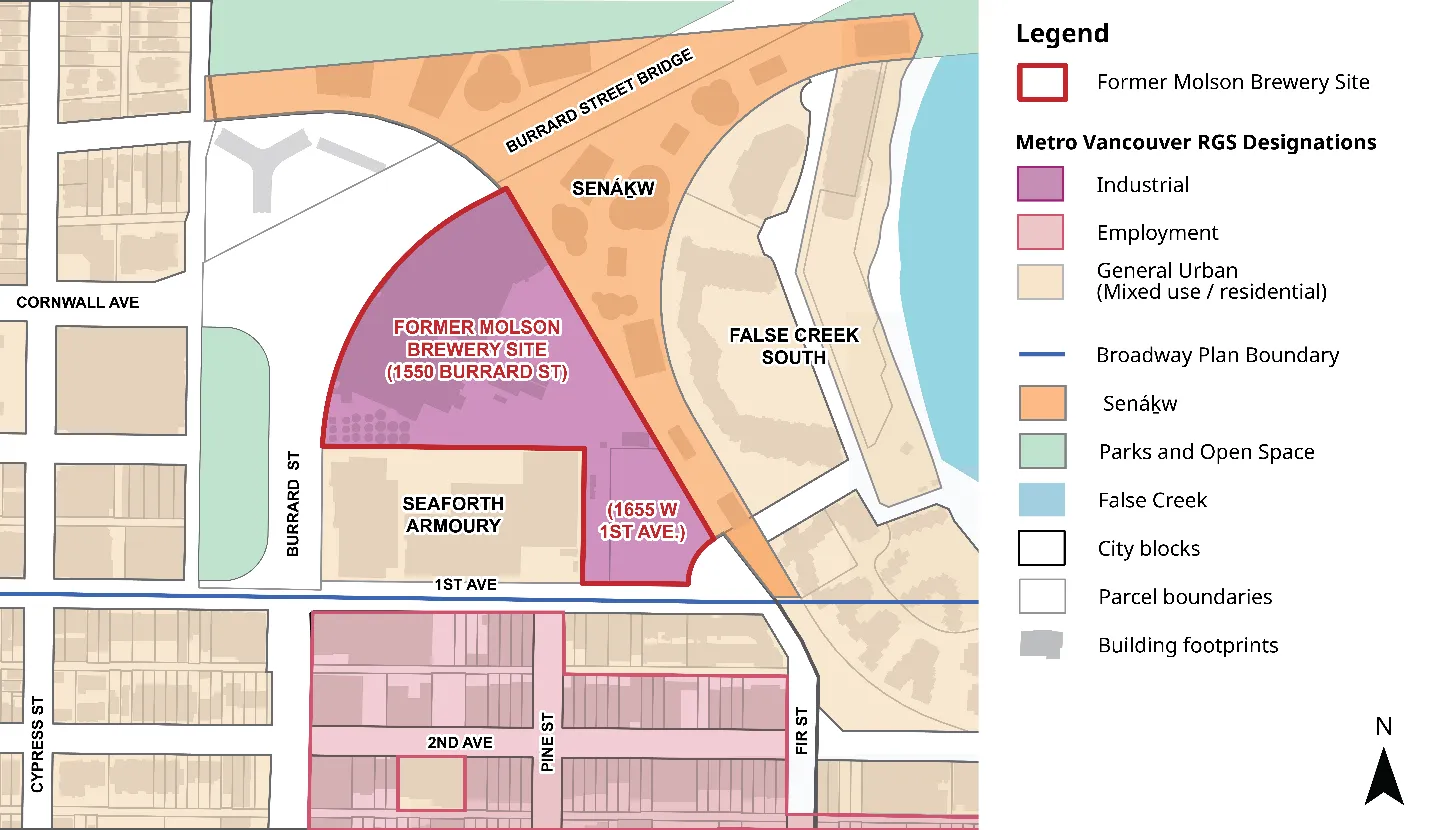
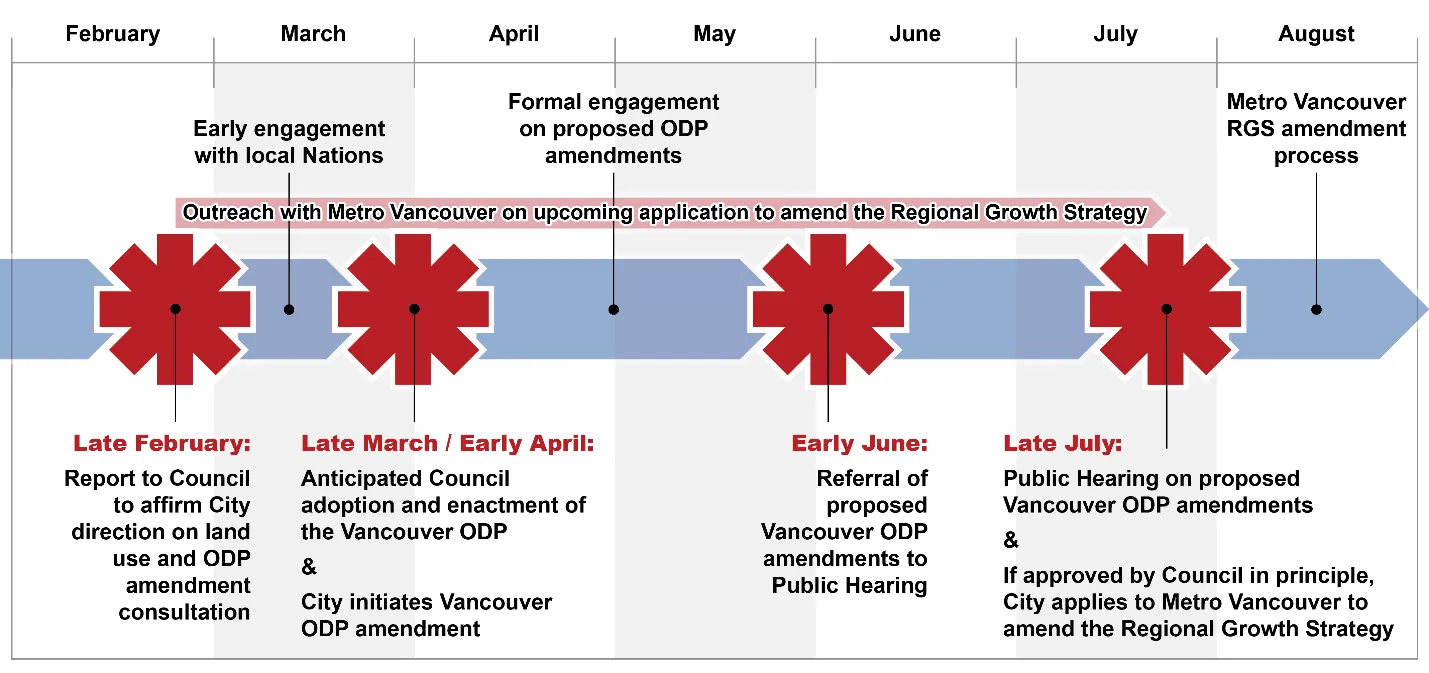
- Staff are seeking Council direction to begin the process of re-designating the former Molson Brewery site (1550 Burrard Street / 1655 West 1st Avenue) from "Industrial and Employment" to "Mixed-Use High-Rise 2" in the Vancouver Official Development Plan (ODP).
- The Molson Brewery operated on the site from 1953 until 2019, when it relocated to a larger facility in Chilliwack; the surrounding False Creek area has since transformed into a mixed-use neighbourhood, making stand-alone heavy industrial use no longer appropriate for the site.
- Unlike the four other "exceptional industrial" sites under review, the Molson site is self-contained and not connected to adjacent industrial lands, which staff say makes it suitable for an accelerated re-designation process ahead of broader planning reviews.
- Staff recommend consulting with Musqueam, Squamish, and Tsleil-Waututh Nations, the Province, Metro Vancouver, TransLink, school boards, and the general public as part of preparing the ODP amendment.
- Staff are also seeking direction to begin discussions with Metro Vancouver about a Regional Growth Strategy amendment to re-designate the site from "Industrial" to "General Urban," a necessary step for any future mixed-use or residential development.
- Approval of this motion does not create any legal rights for the property owner or obligate the City to rezone the site; a Public Hearing would still be required before any by-law changes are enacted.
Report Images
Vote
Public comments
Read all 3 statements
Transcript
90 segments
Great, and that passes unanimously. Thank you very much. Okay, so that completes report number one.
We'll move on to report number six. Issues report proposed land use change for former Molson Brewery exceptional industrial site. Now, before we begin this agenda item, if anyone believes that they have a conflict of interest, now is the time to disclose it. Seeing none, this item does not have a team member presentation. Council, you may have up to five minutes to ask questions of our team members. Are there any questions?
No? Okay. Councillor Maloney.
Thank you. I'm interested to know whether there's been any discussion about this item this site in order of priority compared to the other sites owned by the same developer and why they haven't been developed and whether there's been any attempts to use this as leverage to get better outcomes for the residents of Vancouver.
Good morning, Mayor and Members of Council. Matt Shilito, Director of the Special Projects Office in PDS. Thank you for the question. We do have Peter Webb here from Concord Pacific, who may be best placed to answer the question around priorities for their organization. What I will say is that we have been engaging as staff with Concord on three large sites, a site in Northeast Falls Creek. the old St Paul's site and the Molson site. Of those three, this one has risen to the top of their agenda and therefore we are looking to move that one forward through the first step of a process towards an industrial redesignation of the site.
And how much do you expect the value of this site will appreciate if this process goes ahead?
We haven't done analysis of that yet. We would do so through the rezoning stage. There are essentially three stages to the process for redesignation and approval of this site. This report before you today is the first step of that process, seeks to initiate the first step of that process, which would be a change to the official development plan, the upcoming official development plan designation from industrial and employment to mixed-use high-rise too. The next stage would be seeking an amendment from the Metro Vancouver board to change the designation again to a general urban designation there. And then the following process would be the rezoning. And then that last stage of the process is where we would get into the financial analysis of what is the uplift in land value associated with introducing non-industrial uses, primarily residential in addition to some additional industrial uses. What would be the land value impact of that? And as we do with all our rezonings, what contribution could that land value increase make towards things like public amenities and affordable housing? So that's several steps down the process, but something we would obviously look at carefully at the rezoning stage as we normally do.
And what do you expect the timeframe on that, getting it all the way through rezoning and development permit?
We're a few years away through that. So this first stage of the process, the ODP amendment, we're looking forward to consulting on that and bringing that forward to council at a public hearing in July. That would then go to Metro. They have their own process, which requires approval by the Metro board and engagement with affected parties. And then pending that decision and enactment of that ODP amendment by council, we typically spend a year or more on a rezoning of this scale, likely longer than that to public hearing. There's often an enactment phase beyond that of six months to a year that can be run concurrently with development permits. So we're probably three years away from development permits on this site, assuming, you know, that all those steps work according to the normal process.
And what kind of, I guess, low-impact employment uses could this site be usefully put to, given its situation close to Senac? which is going to have a lot of residential development, even though it's not contiguous with a lot of other industrial lands, what employment opportunities could it be used for if the market conditions, say, were different in a few years' time?
Yeah, so I mean, to be determined through the process and ultimately secured through the rezoning, but some thoughts for now in terms of sort of lighter industrial uses, things like laboratories, creative products manufacturing, production studios. I think we understand the landowner is interested in tech uses, office uses, potentially hotel, retail service uses. So really quite a broad spectrum, including both industrial uses under our existing industrial use definition and non-industrial uses that would nevertheless provide what we call job space, essentially employment generating spaces.
And I think I'm running out of time. Thanks very much.
Yeah, thanks. May I just point out procedure first? I'm just confirming that staff had not prepared a presentation on this at all. Is that correct?
At all? No, there was no overview you were intending to?
I'm happy to provide a one-minute overview if that's helpful. We don't have a formal presentation.
Well, that sort of puts me in a position of using my time, but okay. Maybe I'll just follow up and answer your questions then. Can you just, I think, following up on the previous questions, the page two of the report suggests to redesignate Molson site land use from industrial employment to mixed-use high-rise, too. Can you just perhaps expand, and maybe that is part of that one-minute option on the potential uses? It's commercial, light, industrial, and residential coexisting. Is that correct?
That's right, exactly. A range of light industrial uses that would be compatible with residential, and then a range of other non-industrial uses, thinking of things like retail, services, hotel, office uses, perhaps a tech focus that the Concord Pacific seems interested in pursuing.
Okay, and so following up on that, since you mentioned tech, is there an opportunity with, it's not common, it's pretty rare in the city now, a landlocked city that's becoming more developed and a more mature city over time. Is there an opportunity with a large site like this to be very intentional about that type of use, whether it's tech or a specific type of light industrial or creation of a precinct, for example, that might support a particular sector of our economy?
Yes, I think that's right. I think that's one of the things that makes this site stand out is its size and therefore the opportunity to create a critical mass that might be particularly focused on one sector. And again, I mentioned tech and be partly obviously or significantly in the interest of the landowner to bring forward the mix of uses that they're interested in doing. But yes, a critical mass on a large site like this could form a cluster.
Okay, and as part of the process, would staff be engaging in that dialogue with the landowner?
Certainly, yes. Oh, absolutely. Yeah, through the landowner and all affected parties as under recommendation A, the direction to engage with all affected parties, but the landowner, of course, being one of those.
Okay, two more questions. If the site's current designation remains, what's the likelihood that it would be used based on its current zoning?
Well, we think it's unlikely that it would be used for heavy industrial uses. We don't consider it to be suitable for heavy industrial uses given the increasingly residential context and really the lack of connection that the site has to the trucking network, particularly the highway network and the rail network. It's somewhat orphaned from those and in a very different context with... Residential uses so the kind of heavy industrial uses allowed on the existing zoning We wouldn't see as being compatible with the the emerging context of the site.
Okay. Thanks, and then final question is just read back to the timing piece just clarifying so Potentially a trajectory for a public hearing to this council before July, but a metro designation subsequent to that likely in the fall
That's right. That's the intention. We would formally apply to Metro for a change to the regional growth strategy, you know, pending Council's approval and principle of public hearing on the ODP amendment. And we would look to move that forward as quickly as possible. And, in fact, recommendation B in the report is that we engage with staff at Metro Vancouver to kind of explore the way to expedite that process.
Okay. But likely not until fall.
It wouldn't be until the fall.
Okay. I'm going to leave it there for now and save some time. Thanks.
Thanks very much. Can you just re-frame how this will move through the process with the other four sites that were identified as that initial report that we dealt with last summer? We've talked about Railtown, we've talked about the second in Yukon site, and then there's a few others. So what does that look like?
Yeah, so this is based on the industrial lands framework that covered those five sites. This is the one that's sort of unique, given its circumstances, being a standalone site. And again, we've not considered to be suitable for heavy industry. So we're moving this forward directly through an ODP amendment process. And the other four areas, and it's important to emphasize, there are areas more than one site with multiple considerations, are all being looked at through a planning process. So there's being Railtown, Main and Terminal area, Mount Pleasant, and the Marine Gateway. They are all looking at relative levels of detail and a relatively extensiveness. the potential of all of those sites through area planning processes, and they're all on a track to come forward back to council next year.
Okay, thanks for confirming that. Has there been any discussion with the applicant, and we're not going to be able to ask questions of the speaker who's here representing Concord, so that's why I'm asking it through you, in terms of transportation or options for a light surface rail line or just really what the transportation plan would be should this all happen? happen?
Yeah, that's absolutely a key question that we'll work through in the detail through the rezoning, subject to the principle of the change of use being established. One of the things about this site is it has excellent walking and cycling connections already and the potential to improve them. So improving connections to downtown, to the Broadway subway, improving bus connections again to the Broadway subway and to downtown.
But specifically the light rail line that exists there right now and goes straight to Olympic Village, Canada line.
Yeah, that is the streetcar. Yeah, that is a challenging proposition in terms of creating a viable business case for that. What we understand from our transportation college is a more likely answer in terms of connecting to Olympic villages through a more rapid bus, a dedicated bus service along Second, rather than the streetcar.
Is it possible to have a sort of a fulsome report back on that? Because I know we've actually received proposals from some light rail, surface rail companies that have sort of shown significant interest and also capital investment in that light rail line that may have not seen the light of day, if you will, but maybe should be considered given the size of this development adjacent to Sanhok.
For sure. And we absolutely will consider that as an option and we will look at that and report back as part of the ODP amendment process.
Okay. It was asked before and it's been flagged in the public, so I think it's worth asking. You know, we do have another sort of significant site similar to this in Northeast Falls Creek that has sort of been discussed in various, you know, wide-scale planning meetings efforts and work that the council's done, but sort of how do we manage the imperative to sort of go through all of this process in good faith that something would actually get underway by the developer?
Well, we believe the developer is interested in good faith in moving forward with this project. They've identified it as their highest priority of the three to move forward. We can't compel a developer to move forward with an approval once they get one. So we have limited ability to compel that. I would say, though, that we are also in discussions with the landowner, this landowner around the Northeast Falls Creek site as well, and all rolling up our sleeves with best efforts to try and move that forward too. So it's not exclusive to this site. We're working on all three of the Concord sites, and Northeast Falls Creek is absolutely a priority for the city to move forward as well.
Yes, no, no one's questioning that. Just the Seaforth Armory in terms of Canadian Armed Forces and working with them directly, is there any context or consideration that Council should be aware of at this point?
Yeah, we would work with them as neighbours to this site. They have not approached us in terms of redevelopment plans. The Seaforth Armory building itself is heritage listed. There's a relatively new office building adjacent to that. But as part of a good planning process, we would look at the context. the surrounding sites and see what interest there is in moving forward with compatible development.
Thank you. That's my time.
Thanks very much, Mayor. A lot of my questions just got asked. I was going to ask a little bit about the D&D property as well. And I am sort of in the question with regards to the streetcar. It's my understanding that the rail bed itself has largely been preserved whether it's right up to the Sanok property through past Granville Island and beyond. So for the most part, we're not entirely closing the door. You just said that there isn't a current business case for any kind of ground-based transportation like a rail-based one.
That's correct. I mean, there is infrastructure in place and there is therefore a theoretical opportunity there subject to the business case and also coming forward with what is the most efficient way to move people from this Molson site and the emerging Sanhok development eastwards towards the Olympic Village Station. So we would certainly continue to consider the streetcar as an option among others. I certainly don't mean to rule it out today, but I think it's important to note that It is a challenging proposition in terms of a business case.
It would seem to me, I mean, I know that the Sanhok project is very unique in its way, Molson Land and any other kind of lift that we're going to see off of these areas does potentially present. We're talking significant amount of population growth, especially around Sanhok. So people moving will... increasingly become the the big question what we're doing especially when we've decided this is not going to be a very car oriented development so anyway I look forward to again sort of keeping the flame burning a little bit on on what we might be able to do that route the only other question I have is just with regards to the the transition that might be proposed for this site Sanok being a very bold, very tall residential development that faces the back, the north side of this site, and then the Armory District being more of a commercial, light industrial, you know, car dealerships, various other art studios that faces the south side of the property. How do we sort of envision that kind of, or ask that there be some kind of transition between those two kinds of uses on that property?
Yeah, no, that's a great point. And again, to be determined through a rezoning stage where we would get into those questions of built form. But I think you highlighted the obvious sort of move there, which would be to make a transition in scale from the significant tower scale on Sanok gradually downwards towards the south, towards the armory site and the... and the broad slopes industrial area, the slopes industrial area will remain mid-rise, largely low-rise and mid-rise, so there's an obvious move there to kind of provide some context to Sanark and create a transition in scale. And again, another thing about this site is the size of the site means there's an opportunity for a very wide variety of built forms to create that transition.
I'm just going to pose this question just because the site is adjacent to Department of National Defence land that has been there for a very long time. I imagine working with our federal partners is not an easy thing to do, but we do know that there is a growing conversation around Canada's defence infrastructure. infrastructure and it's the necessity of making sure that the country is stronger in that regard. I would be very interested to see whether our city staff will be undertaking those kind of intergovernmental conversations with regards to this site, again, to make sure that that transition between uses is quite clear and that we're not sort of faced with a... a barbed wire fence that might be there currently to try and make this strictly feel like it's a place to place vehicles, which it has been for many years and so on. I know that there is an office building there now, but it would be interesting to see that kind of work continue between our two governments.
Yeah, absolutely. I mean, we would routinely consult them as a neighbor, but I think you've put your finger on the unique aspect of that site. You know, being a federal and a military government entity, that brings in unique circumstances that we would need to think carefully about and work with them on as a, you know, senior level of government. Yeah.
Thanks, Mayor. Thank you for the updates. Great questions asked by Council. I do have one, and I appreciate it's a bit of a hypothetical, but I think it's worthy of some attention. This is a Type 3 amendment that has to go to Metro Vancouver. And in my experience, last term, the City of Surrey brought a Type 3 amendment going the different direction. It was around 245 hectares of agricultural and rural land. to move to industrial commercial park. It was incredibly contentious at the board. It narrowly passed by that board in the favor of Surrey's request. What happens if the Metro Vancouver board looks at this and says, no, I've heard a number of mayors speaking out about the importance of preserving industrial lands in the region. And where does that leave the city of Vancouver if that were to take place? And I recognize it will be a future board. It won't be the current board that's in place by the time we get there. But could you comment on that and what your experience has been with that?
Yeah, I mean, it is something of a hypothetical and not one that we have faced in the city of Vancouver, to the best of my knowledge. I think, you know, we, having identified this site as somewhat unique, we feel there's a very strong land use rationale for the change of use that we're proposing. And we feel that it matches up well with Metro Vancouver's own criteria for these kinds of redesignations. And with the regional growth strategy, which identifies a number of goals that this redesignation could help to hit. It would be wrong of me to speculate on what we might do should the Metro Vancouver vote turn this redesignation down. We would have to look at that and options to move forward at that time. But I think it's difficult to speculate at the moment.
Thank you. I appreciate that. That's all my questions.
Yeah, thanks. Great questions so far from my colleagues. Thinking about Sanok and the 6,000 units we're expecting there in terms of rental, do we have a sense of what could be achieved on this site, or is it too early in the process?
It's really too early to say in terms of the mix and the quantum of both the job space and the residential. I think we could probably say that even with a very substantial amount of non-residential space, there is probably scope on a size like this in a central location like this to introduce several thousand units. But the number is very much to be determined through the rezoning process.
Okay. And are there any... I guess, requirements at this stage when we're going to seek this amendment from Metro around the tenure of the housing that would be on this site, like rental or strata.
Not requirements per se, but we do know that Metro Vancouver is interested in, as part of one of its goals in its regional growth strategy, a diverse and affordable housing mix. And so, you know, we would certainly be looking on a site like this to be identifying a variety of tenures from social housing through rental, below market rental to, you know, likely condominiums. The exact mix to be determined, again, through the rezoning stage, we have policies that apply to sites like this, large sites like this in the city routinely, and that includes a mix of that kind. But the exact percentages would have to be determined through the rezoning.
Okay. But that policy requiring that mix that you just mentioned, that would be articulated through this process to Metro?
That's right.
Okay. Okay, great. That's it for me. Thanks. Thank you very much, Councillor Orr.
Yeah, thanks for the report. Lots of great questions. Some of them of mine have been asked. But can staff provide a sort of estimate of the value of the removal of the view corridors over St. Paul's and its North Falls Creek sites?
I really wouldn't be able to speculate on that. Not an analysis that we have done. We can certainly do some analysis of the additional height achievable on both of those sites with the view cones removed. But it would be...
challenging to capture to turn that into a into a dollar figure immediately certainly i wouldn't want to speculate that on for sure no i'm just i'm getting a i'm just trying to get a sense of how we're sort of working with these three sort of unique sites are we leveraging them against each other sort of to provide the maximum benefit or are they kind of in isolation
Well, I think we're looking at all of them in isolation on their own merits and the opportunities they create to deliver on the goals that we have as a city, the planning goals we have as a city, whether it's job space, affordable housing, other public benefits. So we don't really look at them as a portfolio as such. They're all quite different, but we certainly do look at them consistently to see how they can deliver on public objectives that are in council policy.
And then just shifting to sort of Mount Pleasant... Do we have an estimate of the number of new jobs that were generated from that densification that has been rapidly happening since the 2010s?
I might ask my colleague Chris Robertson to try and address that. Chris Robertson, Director of Citywide and Regional Planning. We have done some initial work through the Broadway plan. I don't have those figures here with me today, but certainly could get them to Council.
Okay, thanks. That would be cool. And then just sort of in general, our job-related rezonings, this could be for Chris too. Are we seeing a rise or a fall in specific sort of job-related rezonings?
Yeah, what I would say is we've seen a real uptick in interest in primarily industrial-focused employment. Obviously, with the office market downturn, that has declined, but the industrial side of our portfolios hasn't, and we see strong, you know, tenancies and... uh again in the industrial we do expect the the office to recover as well and then you know time's always the you know uh crystal ball effort but uh certainly what we're hearing even from the industry now is that the office is starting to to pick up again too great thanks that that's all my questions thank you councillor fry yeah so i had to go back in time because i actually
In 2016, I wrote about this when I was doing some research work for Adrian Carr when the purchase first happened. And at the time, there was conversation around the Broad Slopes IC District rezoning policy, which I don't see mentioned in this report. Has that Broad Slopes IC District been superseded by Broadway Plan and the regional context statement in its entirety?
That's right. It's been superseded by the Broadway plan in terms of policy for that area. And so there is policy through the Broadway plan to intensify and broaden the mix of job spaces within Barrage Slopes. However, it is maintained as a non-residential area.
Right. And I think it did talk about one-to-one industrial residential, if I'm not mistaken. That was the sort of intent at the time.
There's not residential allowed in the Barrage Slopes industrial area. It's purely commercial and industrial uses.
Interesting, because I seem to have from my notes that it did allow industrial and residential mixed. I guess it's irrelevant, though, because it's been superseded, so we can technically move on from that. Can you just expand upon the relevance of this site as a non-contiguous industrial land, which is a statement that's made in your report here?
Yes, I think the fact that it's a standalone site with a predominantly or at least certainly increasingly residential context, not contiguous with other industrial lands, it's important to mention that the Broad Slopes area is a general employment area rather than an industrial area. And therefore, it's a key question because one of the points that are raised in Metro Vancouver's criteria for addressing these kinds of redesignations is the degree to which the speculative effect might be wider than the site that's being considered for redesignation. And we do consider this to be a standalone, heavy industrial site that's no longer suitable for that use.
So in the context of the regional context statement and industrial land preservation stuff, contiguous sites have more kind of inherent value as industrial land because it's better integrated with infrastructure or that kind of thing?
Or at least, yeah, one needs to start to think about the broader context within it and the size of the industrial area that it's contiguous with, and that becomes an issue or can become an issue in terms of the speculative effect of a redesignation.
And last for me, just because some of the sort of framing around this is an urgency to deal with this as a matter of the ODP, but my understanding is that this, should we approve it, will not necessarily inform the ODP because it still has to go through Metro in the regional context?
That's right. It does. So really what's before council today is a recommendation to initiate the first of a three-step process. And that is to amend the upcoming citywide official development plan that will be coming forward to council for consideration in March. And we would then bring that official development plan amendment back to council. Target of that date for that is July. Then there's the Metro Vancouver Regional Growth Strategy Amendment process, and then rezoning. And so really it's a matter of trying to make this initial step around simply the principle of changing the use designation on the site, noting there is a Metro approval and then a rezoning to follow.
But that needs to be in this ODP that we're mandated to provide the province or by the province?
That's right. So we are not bringing forward this change within the first iteration of the ODP that's coming forward to council in March. And the reason being that then it would be offside with the regional growth strategy and require the whole citywide ODP to be subject to a Metro Vancouver approval, which would jeopardize our provincially mandated deadline of getting the ODP in place by the end of June. So we're doing it subsequent to the first iteration of the CDY and ODP being approved by council.
Okay, so now we're going to hear from registered speakers for this report. Public speakers should state whether they are in support or opposition of the recommendations and may only speak once. I'm also going to ask speakers if they are residents of Vancouver, if not noted.
So our first public speaker is Peter Webb.
Hi, Peter Webb, Senior Vice President, Concord Pacific. Concord Pacific, of course, is a development company, so I'm the guy that's handling the work. The Molson's property at the Barrage Bridgehead was purchased in 2016, I think, as has been pointed out. The site shares a 700-foot property line with the Sanak Project. And Sanak is a First Nations, Squamish... a property under self-governance with federal support for high-density development, effectively rezoning the area. Sanak will be 4.5 million square feet, roughly, and roughly 6,500 residential homes, including towers ranging from 20 to 60 stories. The Molson Brewery facility left the site shortly following the purchase, and the new facility is in Chilliwack, where they have better access to trucking and so on. They took the jobs with them. Wilson left the area due to an inappropriateness of industrial land use on the broadside. And the industrial land use is really a result of there's no railway connection, there's no reasonable truck route, there's no water access for shipping, and it's not continuous with industrial uses in the area.
Industrial designation is primarily a result of the brewery's existence. The use is now obsolete due to nature of the adjacent uses. And it's truly an orphan site, as was discussed earlier. It's a result of the brewery there being itself historically. Concord Division is a mixed-use serving community providing live, work, play opportunities, along with the associated amenities. This is a model of our expo land development over the last 30 years and many of the master plan communities across Canada. In addition, there would, of course, be solutions for the commercial offset or the industrial offset of use. In an effort to recognize the loss of the Molson's job space, Concord is prepared to include an equal amount of commercial space on the new community, matching the square footage of the historic Molson's brewery building. The new job space would facilitate more jobs than ever generated at Molson's. During the history of Molson's on-site, it only ever generated 250 jobs maximum, typically lay around 150 jobs. So we're thinking if we replace the same scale of building... with a revised version of what is industrial these days, it could be up to a couple of thousand jobs based. The new master plan community would be designed to establish a more resolved traffic pattern through the area and could create a more symbiotic relationship with the surrounding community as a result. Honker recognizes and supports the city's efforts in the ODP process and the resulting adoption of a City of Vancouver Metro Land Use Redesignation to General Urban.
Thank you very much. Okay, that is the end of our speaker's list. So Peter, thank you very much for coming in. Would someone like to move a motion? Great, Councillor Claston, seconded by Councillor Zhou. Councillor, is there any discussion? Seeing no one in the queue, I'm going to call up Councillor Maloney.
Thank you. Yeah, I'm concerned about... but Concord has three major properties on False Creek and has seen their value soar without building a single unit. I understand the implications of the changes and that this is an orphan site, but Concord Pacific has sat on the Expo lands for 40 years and has been able to seek rezoning of the Expo lands since 2018 and This includes some of the very best market conditions for loans and homes and lending and market conditions were very good in the early 2020s. If council approves this rezoning down the track, the value of this site will jump. The planning department has just had a substantial budget cut and I can't justify the prioritisation of this work. that has potential to deprioritise other important planning work, particularly when the Expo lands are such a hole in the heart of Vancouver. I mean, it's a parking lot where there should be a vibrant community and it's having effects all around and they could have been avoided by development happening earlier. So we have an opportunity... to exercise leverage against Concord Pacific, and so I say it's time for Concord Pacific to follow through on its 40-year-old commitment, and I'll be voting against this today.
Thanks. Thank you very much. Seeing no one else in the queue, I'm going to call the vote.
Please go to the voting panel. And that passes with Councillor Maloney in opposition. That completes report number six.
Okay. Moving along. Bylaws. We have 14 bylaws on the agenda for enactment. Bylaw number 11 has been withdrawn. Before we begin this agenda item, if anyone believes they have a conflict of interest, now is the time to declare it. Does anybody have a conflict to disclose? Seeing no one in the queue. Bylaw 1 was from the public hearing on February the 10th, 2026. Councillors Frye, Classen, Orr, and Marisim were absent for this item at the public hearing. Councillor Frye, have you reviewed the proceedings and will you be voting on the enactment? Councillor Klassen? Councillor Orr? And I have not and I will not. Would someone like to move the motion to adopt bylaws 1 through 10 and 12 through 15? Councillor Klassen, seconded by Councillor Kirby-Young. Is there... Council, is there any discussion? All those in favour say aye. All those opposed say nay. Great. The motion carries unanimously. The list of approved bylaws can be found on the city's website. Administrative motions. Number one, closure and sale of a portion of road adjacent to 1710 through 1730 East Penter Street. Before we begin, does anybody believe that they have a conflict of interest they need to disclose? Great. Council, are there any questions for team members?
Statement Watch
Good morning, Mayor and Members of Council. Matt Shilito, Director of the Special Projects Office in PDS. Thank you for the question. We do have Peter Webb here from Concord Pacific, who may be best placed to answer the question around priorities for their organization. What I will say is that we have been engaging as staff with Concord on three large sites, a site in Northeast Falls Creek. the old St Paul's site and the Molson site. Of those three, this one has risen to the top of their agenda and therefore we are looking to move that one forward through the first step of a process towards an industrial redesignation of the site.
And how much do you expect the value of this site will appreciate if this process goes ahead?
We haven't done analysis of that yet. We would do so through the rezoning stage. There are essentially three stages to the process for redesignation and approval of this site. This report before you today is the first step of that process, seeks to initiate the first step of that process, which would be a change to the official development plan, the upcoming official development plan designation from industrial and employment to mixed-use high-rise too. The next stage would be seeking an amendment from the Metro Vancouver board to change the designation again to a general urban designation there. And then the following process would be the rezoning. And then that last stage of the process is where we would get into the financial analysis of what is the uplift in land value associated with introducing non-industrial uses, primarily residential in addition to some additional industrial uses. What would be the land value impact of that? And as we do with all our rezonings, what contribution could that land value increase make towards things like public amenities and affordable housing? So that's several steps down the process, but something we would obviously look at carefully at the rezoning stage as we normally do.
And what do you expect the timeframe on that, getting it all the way through rezoning and development permit?
We're a few years away through that. So this first stage of the process, the ODP amendment, we're looking forward to consulting on that and bringing that forward to council at a public hearing in July. That would then go to Metro. They have their own process, which requires approval by the Metro board and engagement with affected parties. And then pending that decision and enactment of that ODP amendment by council, we typically spend a year or more on a rezoning of this scale, likely longer than that to public hearing. There's often an enactment phase beyond that of six months to a year that can be run concurrently with development permits. So we're probably three years away from development permits on this site, assuming, you know, that all those steps work according to the normal process.
And what kind of, I guess, low-impact employment uses could this site be usefully put to, given its situation close to Senac? which is going to have a lot of residential development, even though it's not contiguous with a lot of other industrial lands, what employment opportunities could it be used for if the market conditions, say, were different in a few years' time?
Yeah, so I mean, to be determined through the process and ultimately secured through the rezoning, but some thoughts for now in terms of sort of lighter industrial uses, things like laboratories, creative products manufacturing, production studios. I think we understand the landowner is interested in tech uses, office uses, potentially hotel, retail service uses. So really quite a broad spectrum, including both industrial uses under our existing industrial use definition and non-industrial uses that would nevertheless provide what we call job space, essentially employment generating spaces.
And I think I'm running out of time. Thanks very much.
Thank you very much, Councillor Kirby-Young.
Yeah, thanks. May I just point out procedure first? I'm just confirming that staff had not prepared a presentation on this at all. Is that correct?
Yeah, that's correct.
At all? No, there was no overview you were intending to?
I'm happy to provide a one-minute overview if that's helpful. We don't have a formal presentation.
Well, that sort of puts me in a position of using my time, but okay. Maybe I'll just follow up and answer your questions then. Can you just, I think, following up on the previous questions, the page two of the report suggests to redesignate Molson site land use from industrial employment to mixed-use high-rise, too. Can you just perhaps expand, and maybe that is part of that one-minute option on the potential uses? It's commercial, light, industrial, and residential coexisting. Is that correct?
That's right, exactly. A range of light industrial uses that would be compatible with residential, and then a range of other non-industrial uses, thinking of things like retail, services, hotel, office uses, perhaps a tech focus that the Concord Pacific seems interested in pursuing.
Okay, and so following up on that, since you mentioned tech, is there an opportunity with, it's not common, it's pretty rare in the city now, a landlocked city that's becoming more developed and a more mature city over time. Is there an opportunity with a large site like this to be very intentional about that type of use, whether it's tech or a specific type of light industrial or creation of a precinct, for example, that might support a particular sector of our economy?
Yes, I think that's right. I think that's one of the things that makes this site stand out is its size and therefore the opportunity to create a critical mass that might be particularly focused on one sector. And again, I mentioned tech and be partly obviously or significantly in the interest of the landowner to bring forward the mix of uses that they're interested in doing. But yes, a critical mass on a large site like this could form a cluster.
Okay, and as part of the process, would staff be engaging in that dialogue with the landowner?
Certainly, yes. Oh, absolutely. Yeah, through the landowner and all affected parties as under recommendation A, the direction to engage with all affected parties, but the landowner, of course, being one of those.
Okay, two more questions. If the site's current designation remains, what's the likelihood that it would be used based on its current zoning?
Well, we think it's unlikely that it would be used for heavy industrial uses. We don't consider it to be suitable for heavy industrial uses given the increasingly residential context and really the lack of connection that the site has to the trucking network, particularly the highway network and the rail network. It's somewhat orphaned from those and in a very different context with... Residential uses so the kind of heavy industrial uses allowed on the existing zoning We wouldn't see as being compatible with the the emerging context of the site.
Okay. Thanks, and then final question is just read back to the timing piece just clarifying so Potentially a trajectory for a public hearing to this council before July, but a metro designation subsequent to that likely in the fall
That's right. That's the intention. We would formally apply to Metro for a change to the regional growth strategy, you know, pending Council's approval and principle of public hearing on the ODP amendment. And we would look to move that forward as quickly as possible. And, in fact, recommendation B in the report is that we engage with staff at Metro Vancouver to kind of explore the way to expedite that process.
Okay. But likely not until fall.
It wouldn't be until the fall.
Okay. I'm going to leave it there for now and save some time. Thanks.
Thank you very much, Councillor Bligh.
Thanks very much. Can you just re-frame how this will move through the process with the other four sites that were identified as that initial report that we dealt with last summer? We've talked about Railtown, we've talked about the second in Yukon site, and then there's a few others. So what does that look like?
Yeah, so this is based on the industrial lands framework that covered those five sites. This is the one that's sort of unique, given its circumstances, being a standalone site. And again, we've not considered to be suitable for heavy industry. So we're moving this forward directly through an ODP amendment process. And the other four areas, and it's important to emphasize, there are areas more than one site with multiple considerations, are all being looked at through a planning process. So there's being Railtown, Main and Terminal area, Mount Pleasant, and the Marine Gateway. They are all looking at relative levels of detail and a relatively extensiveness. the potential of all of those sites through area planning processes, and they're all on a track to come forward back to council next year.
Okay, thanks for confirming that. Has there been any discussion with the applicant, and we're not going to be able to ask questions of the speaker who's here representing Concord, so that's why I'm asking it through you, in terms of transportation or options for a light surface rail line or just really what the transportation plan would be should this all happen? happen?
Yeah, that's absolutely a key question that we'll work through in the detail through the rezoning, subject to the principle of the change of use being established. One of the things about this site is it has excellent walking and cycling connections already and the potential to improve them. So improving connections to downtown, to the Broadway subway, improving bus connections again to the Broadway subway and to downtown.
But specifically the light rail line that exists there right now and goes straight to Olympic Village, Canada line.
Yeah, that is the streetcar. Yeah, that is a challenging proposition in terms of creating a viable business case for that. What we understand from our transportation college is a more likely answer in terms of connecting to Olympic villages through a more rapid bus, a dedicated bus service along Second, rather than the streetcar.
Is it possible to have a sort of a fulsome report back on that? Because I know we've actually received proposals from some light rail, surface rail companies that have sort of shown significant interest and also capital investment in that light rail line that may have not seen the light of day, if you will, but maybe should be considered given the size of this development adjacent to Sanhok.
For sure. And we absolutely will consider that as an option and we will look at that and report back as part of the ODP amendment process.
Okay. It was asked before and it's been flagged in the public, so I think it's worth asking. You know, we do have another sort of significant site similar to this in Northeast Falls Creek that has sort of been discussed in various, you know, wide-scale planning meetings efforts and work that the council's done, but sort of how do we manage the imperative to sort of go through all of this process in good faith that something would actually get underway by the developer?
Well, we believe the developer is interested in good faith in moving forward with this project. They've identified it as their highest priority of the three to move forward. We can't compel a developer to move forward with an approval once they get one. So we have limited ability to compel that. I would say, though, that we are also in discussions with the landowner, this landowner around the Northeast Falls Creek site as well, and all rolling up our sleeves with best efforts to try and move that forward too. So it's not exclusive to this site. We're working on all three of the Concord sites, and Northeast Falls Creek is absolutely a priority for the city to move forward as well.
Yes, no, no one's questioning that. Just the Seaforth Armory in terms of Canadian Armed Forces and working with them directly, is there any context or consideration that Council should be aware of at this point?
Yeah, we would work with them as neighbours to this site. They have not approached us in terms of redevelopment plans. The Seaforth Armory building itself is heritage listed. There's a relatively new office building adjacent to that. But as part of a good planning process, we would look at the context. the surrounding sites and see what interest there is in moving forward with compatible development.
Thank you. That's my time.
Thank you, Councillor Claassen.
Thanks very much, Mayor. A lot of my questions just got asked. I was going to ask a little bit about the D&D property as well. And I am sort of in the question with regards to the streetcar. It's my understanding that the rail bed itself has largely been preserved whether it's right up to the Sanok property through past Granville Island and beyond. So for the most part, we're not entirely closing the door. You just said that there isn't a current business case for any kind of ground-based transportation like a rail-based one.
That's correct. I mean, there is infrastructure in place and there is therefore a theoretical opportunity there subject to the business case and also coming forward with what is the most efficient way to move people from this Molson site and the emerging Sanhok development eastwards towards the Olympic Village Station. So we would certainly continue to consider the streetcar as an option among others. I certainly don't mean to rule it out today, but I think it's important to note that It is a challenging proposition in terms of a business case.
It would seem to me, I mean, I know that the Sanhok project is very unique in its way, Molson Land and any other kind of lift that we're going to see off of these areas does potentially present. We're talking significant amount of population growth, especially around Sanhok. So people moving will... increasingly become the the big question what we're doing especially when we've decided this is not going to be a very car oriented development so anyway I look forward to again sort of keeping the flame burning a little bit on on what we might be able to do that route the only other question I have is just with regards to the the transition that might be proposed for this site Sanok being a very bold, very tall residential development that faces the back, the north side of this site, and then the Armory District being more of a commercial, light industrial, you know, car dealerships, various other art studios that faces the south side of the property. How do we sort of envision that kind of, or ask that there be some kind of transition between those two kinds of uses on that property?
Yeah, no, that's a great point. And again, to be determined through a rezoning stage where we would get into those questions of built form. But I think you highlighted the obvious sort of move there, which would be to make a transition in scale from the significant tower scale on Sanok gradually downwards towards the south, towards the armory site and the... and the broad slopes industrial area, the slopes industrial area will remain mid-rise, largely low-rise and mid-rise, so there's an obvious move there to kind of provide some context to Sanark and create a transition in scale. And again, another thing about this site is the size of the site means there's an opportunity for a very wide variety of built forms to create that transition.
I'm just going to pose this question just because the site is adjacent to Department of National Defence land that has been there for a very long time. I imagine working with our federal partners is not an easy thing to do, but we do know that there is a growing conversation around Canada's defence infrastructure. infrastructure and it's the necessity of making sure that the country is stronger in that regard. I would be very interested to see whether our city staff will be undertaking those kind of intergovernmental conversations with regards to this site, again, to make sure that that transition between uses is quite clear and that we're not sort of faced with a... a barbed wire fence that might be there currently to try and make this strictly feel like it's a place to place vehicles, which it has been for many years and so on. I know that there is an office building there now, but it would be interesting to see that kind of work continue between our two governments.
Yeah, absolutely. I mean, we would routinely consult them as a neighbor, but I think you've put your finger on the unique aspect of that site. You know, being a federal and a military government entity, that brings in unique circumstances that we would need to think carefully about and work with them on as a, you know, senior level of government. Yeah.
Okay. Those are my questions. Thank you, Matt. Thank you. Councillor Dominato.
Thanks, Mayor. Thank you for the updates. Great questions asked by Council. I do have one, and I appreciate it's a bit of a hypothetical, but I think it's worthy of some attention. This is a Type 3 amendment that has to go to Metro Vancouver. And in my experience, last term, the City of Surrey brought a Type 3 amendment going the different direction. It was around 245 hectares of agricultural and rural land. to move to industrial commercial park. It was incredibly contentious at the board. It narrowly passed by that board in the favor of Surrey's request. What happens if the Metro Vancouver board looks at this and says, no, I've heard a number of mayors speaking out about the importance of preserving industrial lands in the region. And where does that leave the city of Vancouver if that were to take place? And I recognize it will be a future board. It won't be the current board that's in place by the time we get there. But could you comment on that and what your experience has been with that?
Yeah, I mean, it is something of a hypothetical and not one that we have faced in the city of Vancouver, to the best of my knowledge. I think, you know, we, having identified this site as somewhat unique, we feel there's a very strong land use rationale for the change of use that we're proposing. And we feel that it matches up well with Metro Vancouver's own criteria for these kinds of redesignations. And with the regional growth strategy, which identifies a number of goals that this redesignation could help to hit. It would be wrong of me to speculate on what we might do should the Metro Vancouver vote turn this redesignation down. We would have to look at that and options to move forward at that time. But I think it's difficult to speculate at the moment.
Thank you. I appreciate that. That's all my questions.
Thank you, Councillor Meiszner.
Yeah, thanks. Great questions so far from my colleagues. Thinking about Sanok and the 6,000 units we're expecting there in terms of rental, do we have a sense of what could be achieved on this site, or is it too early in the process?
It's really too early to say in terms of the mix and the quantum of both the job space and the residential. I think we could probably say that even with a very substantial amount of non-residential space, there is probably scope on a size like this in a central location like this to introduce several thousand units. But the number is very much to be determined through the rezoning process.
Okay. And are there any... I guess, requirements at this stage when we're going to seek this amendment from Metro around the tenure of the housing that would be on this site, like rental or strata.
Not requirements per se, but we do know that Metro Vancouver is interested in, as part of one of its goals in its regional growth strategy, a diverse and affordable housing mix. And so, you know, we would certainly be looking on a site like this to be identifying a variety of tenures from social housing through rental, below market rental to, you know, likely condominiums. The exact mix to be determined, again, through the rezoning stage, we have policies that apply to sites like this, large sites like this in the city routinely, and that includes a mix of that kind. But the exact percentages would have to be determined through the rezoning.
Okay. But that policy requiring that mix that you just mentioned, that would be articulated through this process to Metro?
That's right.
Okay. Okay, great. That's it for me. Thanks. Thank you very much, Councillor Orr.
Yeah, thanks for the report. Lots of great questions. Some of them of mine have been asked. But can staff provide a sort of estimate of the value of the removal of the view corridors over St. Paul's and its North Falls Creek sites?
I really wouldn't be able to speculate on that. Not an analysis that we have done. We can certainly do some analysis of the additional height achievable on both of those sites with the view cones removed. But it would be...
challenging to capture to turn that into a into a dollar figure immediately certainly i wouldn't want to speculate that on for sure no i'm just i'm getting a i'm just trying to get a sense of how we're sort of working with these three sort of unique sites are we leveraging them against each other sort of to provide the maximum benefit or are they kind of in isolation
Well, I think we're looking at all of them in isolation on their own merits and the opportunities they create to deliver on the goals that we have as a city, the planning goals we have as a city, whether it's job space, affordable housing, other public benefits. So we don't really look at them as a portfolio as such. They're all quite different, but we certainly do look at them consistently to see how they can deliver on public objectives that are in council policy.
And then just shifting to sort of Mount Pleasant... Do we have an estimate of the number of new jobs that were generated from that densification that has been rapidly happening since the 2010s?
I might ask my colleague Chris Robertson to try and address that. Chris Robertson, Director of Citywide and Regional Planning. We have done some initial work through the Broadway plan. I don't have those figures here with me today, but certainly could get them to Council.
Okay, thanks. That would be cool. And then just sort of in general, our job-related rezonings, this could be for Chris too. Are we seeing a rise or a fall in specific sort of job-related rezonings?
Yeah, what I would say is we've seen a real uptick in interest in primarily industrial-focused employment. Obviously, with the office market downturn, that has declined, but the industrial side of our portfolios hasn't, and we see strong, you know, tenancies and... uh again in the industrial we do expect the the office to recover as well and then you know time's always the you know uh crystal ball effort but uh certainly what we're hearing even from the industry now is that the office is starting to to pick up again too great thanks that that's all my questions thank you councillor fry yeah so i had to go back in time because i actually
In 2016, I wrote about this when I was doing some research work for Adrian Carr when the purchase first happened. And at the time, there was conversation around the Broad Slopes IC District rezoning policy, which I don't see mentioned in this report. Has that Broad Slopes IC District been superseded by Broadway Plan and the regional context statement in its entirety?
That's right. It's been superseded by the Broadway plan in terms of policy for that area. And so there is policy through the Broadway plan to intensify and broaden the mix of job spaces within Barrage Slopes. However, it is maintained as a non-residential area.
Right. And I think it did talk about one-to-one industrial residential, if I'm not mistaken. That was the sort of intent at the time.
There's not residential allowed in the Barrage Slopes industrial area. It's purely commercial and industrial uses.
Interesting, because I seem to have from my notes that it did allow industrial and residential mixed. I guess it's irrelevant, though, because it's been superseded, so we can technically move on from that. Can you just expand upon the relevance of this site as a non-contiguous industrial land, which is a statement that's made in your report here?
Yes, I think the fact that it's a standalone site with a predominantly or at least certainly increasingly residential context, not contiguous with other industrial lands, it's important to mention that the Broad Slopes area is a general employment area rather than an industrial area. And therefore, it's a key question because one of the points that are raised in Metro Vancouver's criteria for addressing these kinds of redesignations is the degree to which the speculative effect might be wider than the site that's being considered for redesignation. And we do consider this to be a standalone, heavy industrial site that's no longer suitable for that use.
So in the context of the regional context statement and industrial land preservation stuff, contiguous sites have more kind of inherent value as industrial land because it's better integrated with infrastructure or that kind of thing?
Or at least, yeah, one needs to start to think about the broader context within it and the size of the industrial area that it's contiguous with, and that becomes an issue or can become an issue in terms of the speculative effect of a redesignation.
And last for me, just because some of the sort of framing around this is an urgency to deal with this as a matter of the ODP, but my understanding is that this, should we approve it, will not necessarily inform the ODP because it still has to go through Metro in the regional context?
That's right. It does. So really what's before council today is a recommendation to initiate the first of a three-step process. And that is to amend the upcoming citywide official development plan that will be coming forward to council for consideration in March. And we would then bring that official development plan amendment back to council. Target of that date for that is July. Then there's the Metro Vancouver Regional Growth Strategy Amendment process, and then rezoning. And so really it's a matter of trying to make this initial step around simply the principle of changing the use designation on the site, noting there is a Metro approval and then a rezoning to follow.
But that needs to be in this ODP that we're mandated to provide the province or by the province?
That's right. So we are not bringing forward this change within the first iteration of the ODP that's coming forward to council in March. And the reason being that then it would be offside with the regional growth strategy and require the whole citywide ODP to be subject to a Metro Vancouver approval, which would jeopardize our provincially mandated deadline of getting the ODP in place by the end of June. So we're doing it subsequent to the first iteration of the CDY and ODP being approved by council.
Statement Watch
I might ask my colleague Chris Robertson to try and address that. Chris Robertson, Director of Citywide and Regional Planning. We have done some initial work through the Broadway plan. I don't have those figures here with me today, but certainly could get them to Council.
Okay, thanks. That would be cool. And then just sort of in general, our job-related rezonings, this could be for Chris too. Are we seeing a rise or a fall in specific sort of job-related rezonings?
Yeah, what I would say is we've seen a real uptick in interest in primarily industrial-focused employment. Obviously, with the office market downturn, that has declined, but the industrial side of our portfolios hasn't, and we see strong, you know, tenancies and... uh again in the industrial we do expect the the office to recover as well and then you know time's always the you know uh crystal ball effort but uh certainly what we're hearing even from the industry now is that the office is starting to to pick up again too great thanks that that's all my questions thank you councillor fry yeah so i had to go back in time because i actually
Statement Watch
Hi, Peter Webb, Senior Vice President, Concord Pacific. Concord Pacific, of course, is a development company, so I'm the guy that's handling the work. The Molson's property at the Barrage Bridgehead was purchased in 2016, I think, as has been pointed out. The site shares a 700-foot property line with the Sanak Project. And Sanak is a First Nations, Squamish... a property under self-governance with federal support for high-density development, effectively rezoning the area. Sanak will be 4.5 million square feet, roughly, and roughly 6,500 residential homes, including towers ranging from 20 to 60 stories. The Molson Brewery facility left the site shortly following the purchase, and the new facility is in Chilliwack, where they have better access to trucking and so on. They took the jobs with them. Wilson left the area due to an inappropriateness of industrial land use on the broadside. And the industrial land use is really a result of there's no railway connection, there's no reasonable truck route, there's no water access for shipping, and it's not continuous with industrial uses in the area. Industrial designation is primarily a result of the brewery's existence. The use is now obsolete due to nature of the adjacent uses. And it's truly an orphan site, as was discussed earlier. It's a result of the brewery there being itself historically. Concord Division is a mixed-use serving community providing live, work, play opportunities, along with the associated amenities. This is a model of our expo land development over the last 30 years and many of the master plan communities across Canada. In addition, there would, of course, be solutions for the commercial offset or the industrial offset of use. In an effort to recognize the loss of the Molson's job space, Concord is prepared to include an equal amount of commercial space on the new community, matching the square footage of the historic Molson's brewery building. The new job space would facilitate more jobs than ever generated at Molson's. During the history of Molson's on-site, it only ever generated 250 jobs maximum, typically lay around 150 jobs. So we're thinking if we replace the same scale of building... with a revised version of what is industrial these days, it could be up to a couple of thousand jobs based. The new master plan community would be designed to establish a more resolved traffic pattern through the area and could create a more symbiotic relationship with the surrounding community as a result. Honker recognizes and supports the city's efforts in the ODP process and the resulting adoption of a City of Vancouver Metro Land Use Redesignation to General Urban.